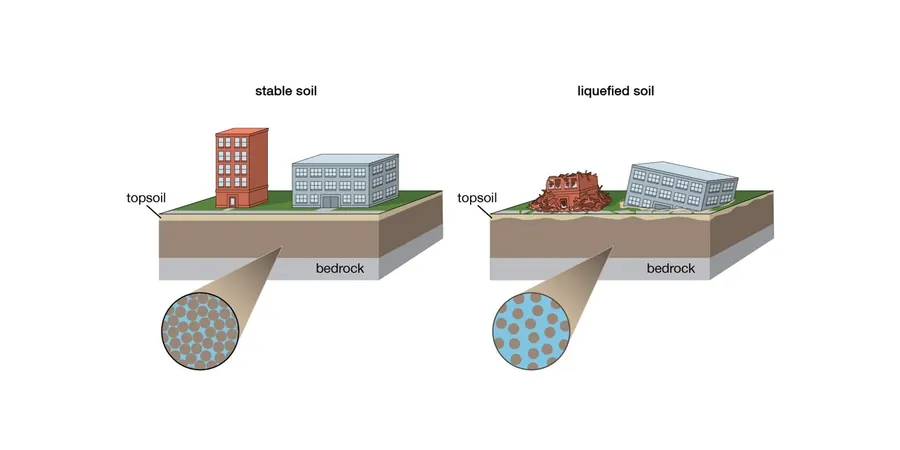
Boise sits just 40 miles from the active Western Snake River Plain fault system, and the Idaho Geological Survey maps extensive Quaternary alluvium across the valley floor. That combination means loose, saturated sands under a shallow water table can liquefy during a design-level earthquake. The 2020 M6.5 Stanley event—felt strongly in Boise—reminded owners and structural engineers that basin amplification is real. A defensible liquefaction analysis starts with proper SPT refusal tracking, fines content from wash, and peak ground acceleration from the latest USGS NSHM. Lacking that, a site classified by default as Site Class D under ASCE 7-22 can mask a real liquefaction hazard that doubles foundation cost after grading is done. For deeper profiling where SPT energy losses become large, we often pair the standard penetration program with a CPT test to get continuous tip resistance and sleeve friction, which clarifies thin liquefiable lenses that split-spoon intervals can miss.
A factor of safety below 1.1 for a saturated layer at 10 feet can add 2.5 inches of differential settlement—enough to crack partition walls and break utility connections.
Our approach and scope
Local ground factors
The Treasure Valley's semi-arid climate hides a shallow aquifer that rises fast during spring runoff from the Boise Front. A site that looks dry in August can have groundwater at 3 feet by March, turning a non-liquefiable profile into a risky one overnight. Owners who skip winter drilling or rely on boring logs from the dry season often get a rude correction when the city reviewer asks for a wet-season re-evaluation. The bigger exposure is lateral spreading along the Boise River corridor, where even a 1 percent free-face slope toward the channel can translate into inches of permanent displacement under a M6.5 scenario. That movement tears apart pile caps, pulls utilities apart at the building line, and voids the performance-based design assumptions the structural engineer used. A proper screening—including Atterberg limits on the fine fraction—distinguishes plastic silts that don't liquefy from non-plastic silts that do, avoiding costly over-treatment.
Relevant standards
ASCE 7-22 Chapter 20: Site Classification and Seismic Design Parameters, ASTM D1586-18: Standard Test Method for Standard Penetration Test (SPT) and Split-Barrel Sampling, ASTM D2487-17: Unified Soil Classification System (for fines classification), Idaho Building Code 2020 (IBC 2018 with state amendments), NCEER/NSF 1997: Summary Report on Liquefaction Triggering (Youd & Idriss).
Other technical services
SPT-Based Liquefaction Screening and Settlement Analysis
Complete field program with automatic SPT hammer, mud-rotary drilling through the saturated zone, and split-spoon samples at 2.5-foot intervals to 50 feet. Lab testing includes grain size distribution, Atterberg limits, and fines content on every sample below the water table. The report delivers layer-by-layer factor of safety using the Seed-Idriss simplified procedure, post-liquefaction settlement via Ishihara-Yoshimine, and lateral spreading displacement per the Youd empirical model. Delivered as a sealed geotechnical letter suitable for city of Boise permit submittal.
Ground Improvement Design for Liquefaction Mitigation
When screening shows FS < 1.1, we develop a performance specification for stone columns, deep soil mixing, or vibrocompaction depending on site access and proximity to existing structures. The package includes target N1,60 values for verification, pore pressure dissipation estimates, and a post-treatment re-evaluation that upgrades the site class. We coordinate with the specialty contractor during trial installation and full production to confirm that densification reaches the design depth and that QA/QC testing—usually CPT soundings—validates the improvement.
Typical parameters
Common questions
Do all Boise sites with shallow groundwater need a liquefaction analysis?
Not automatically. The IBC and ASCE 7-22 require it when the site is mapped as Site Class D, E, or F and the water table is within 50 feet of grade. If the upper 30 feet is clean gravel or stiff clay above the water table, the hazard is low. But much of the Boise River corridor and the older floodplain deposits south of the Bench have loose Holocene sands that warrant screening. A review of the Idaho Geological Survey's Quaternary map and a single deep boring can often confirm whether a full analysis is needed.
What does a liquefaction analysis cost for a typical commercial lot in Boise?
If my site shows marginal liquefaction, can I just deepen the footings instead of treating the soil?
Deepening footings past the liquefiable layer is possible if the competent stratum is within a practical depth—usually 10 to 15 feet—and the structural system can handle the longer column length. But in Boise's river corridor, the liquefiable zone often extends to 25 feet or more, making deep footings uneconomical compared to ground improvement. You also have to check that the deeper bearing layer is not itself susceptible to strength loss from excess pore pressure generated in the overlying liquefied soil.