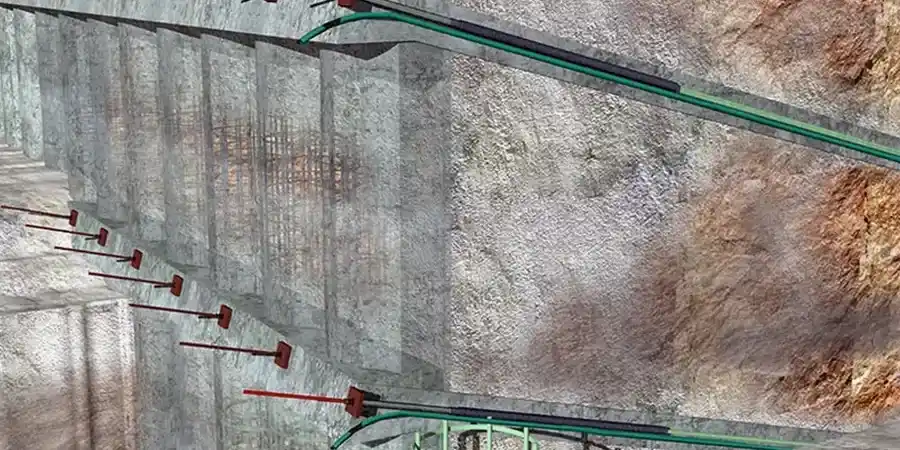
Boise sits at 2,704 feet above sea level on the edge of the Idaho Batholith, where decomposed granite and alluvial fan deposits create highly variable anchorage conditions. The city's rapid growth in the last decade has pushed development into foothill terrain that demands sophisticated active and passive anchor design to manage cut slopes, retaining structures, and foundation uplift. The 2020 M6.5 Stanley earthquake, felt strongly across the Treasure Valley, reminded local engineers that Boise is not immune to seismic loading. For projects near the Boise River or along the Bench, anchor bond zones must account for both the weathered granite typical of the foothills and the interbedded silts of the floodplain. A properly designed system integrates slope stability evaluation when anchorages are intended to restrain natural or engineered slopes, and retaining walls analysis when the anchors serve as tiebacks for cast-in-place or MSE wall construction.
Bond stress in Boise's decomposed granite can reach 150 psi, but a single cobble in the bond zone changes everything.
Our approach and scope
Local ground factors
The anchor stressing operation in Boise uses a center-hole hydraulic jack reacting against a bearing plate, with load monitored by a calibrated pressure gauge and a digital load cell for performance testing. The critical risk during anchor installation in the foothills is hitting a buried granite corestone that deflects the drill bit and creates an irregular bond zone geometry. This can lead to incomplete grout encapsulation and a stress concentration that initiates tendon corrosion, even with double-corrosion protection. In the alluvial deposits near the Boise Airport, loose sands can collapse the drill hole before the tendon is inserted, requiring temporary casing that complicates the grouting sequence. A secondary concern specific to the Treasure Valley is the presence of geothermal groundwater with elevated sulfate content, which accelerates chemical attack on steel tendons if the grout mix design does not include sulfate-resistant cement or supplementary cementitious materials.
Relevant standards
PTI DC35.1-14: Recommendations for Prestressed Rock and Soil Anchors, FHWA-IF-99-015: Ground Anchors and Anchored Systems, ASTM A416/A416M-18: Standard Specification for Low-Relaxation, Seven-Wire Steel Strand for Prestressed Concrete, EN 1537:2013 (referenced for corrosion protection detailing), and ASCE 7-22 Minimum Design Loads and Associated Criteria for Buildings and Other Structures are essential technical references for active and passive anchor design in Boise.
Other technical services
Tieback Anchor Design for Retaining Walls
Design of active post-tensioned tiebacks for soldier pile and lagging walls, diaphragm walls, and MSE wall facings. Includes calculation of unbonded and bond lengths, anchor spacing, and lock-off load specification based on lateral earth pressures and surcharge conditions per FHWA guidelines.
Rock Bolt and Passive Anchor Systems
Fully grouted passive anchors and rock dowels for slope stabilization and rockfall protection in Boise's foothill terrain. Design considers joint spacing, discontinuity orientation, and freeze-thaw durability requirements specific to the Idaho Batholith.
Anchor Testing and Verification
Performance testing, proof testing, and extended creep testing per PTI DC35.1. Includes lift-off testing to verify residual load in existing anchors and preparation of testing submittals for the City of Boise Public Works Department review.
Typical parameters
Common questions
What is the typical cost range for anchor design services for a retaining wall project in Boise?
What is the difference between active and passive anchors for a Boise project?
Active anchors are post-tensioned after grouting to a specified lock-off load, immediately applying force to the structure and limiting movement. Passive anchors are not stressed; they mobilize resistance only when the retained soil or rock mass begins to displace. In Boise, active anchors are preferred for permanent walls where settlement-sensitive utilities or structures are nearby, while passive anchors are effective for temporary excavation support and rock slope reinforcement where some deformation is acceptable.
How does Boise's decomposed granite affect anchor bond capacity?
Decomposed granite in the Boise foothills retains much of the original crystalline structure but is friable and can be excavated with moderate equipment. Bond stresses for gravity-grouted anchors in this material typically range from 50 to 150 psi depending on the degree of weathering and confining pressure. The main challenge is variability: a single corestone boulder embedded in the weathered matrix can deflect the drill path and create an irregular borehole that complicates grouting and reduces effective bond area.
What seismic provisions apply to permanent anchor design in Boise?
Boise falls within Seismic Design Category C per ASCE 7-22, which requires that permanent ground anchors be designed for the seismic earth pressures calculated using the Mononobe-Okabe method or equivalent. Anchor tendons must accommodate the additional cyclic load demand without yielding, and the bond length must extend beyond any potential failure surface that could be activated during the design earthquake. The FHWA GEC No. 4 manual provides detailed guidance on incorporating seismic loads into anchor design for retaining structures.