The number one mistake we see on Boise jobsites is treating a slope like a vertical cut. You cannot bench into the Table Rock sandstone the same way you would in the clay-rich terraces near the Boise River. We get called in after the first sloughing event. By then, the repair costs triple. A proper slope stability analysis maps the failure surface before excavation starts. We run consolidated-undrained triaxial tests in our ISO 17025 accredited lab to feed real strength parameters into the model. For sites with colluvium over basalt, we often pair this with test pits to confirm the contact depth before running limit equilibrium runs in Slide2 or SLOPE/W.
A slope that stands at 1H:1V in August can fail at 2H:1V in February when pore pressures rise in the colluvium.
Our approach and scope
Local ground factors
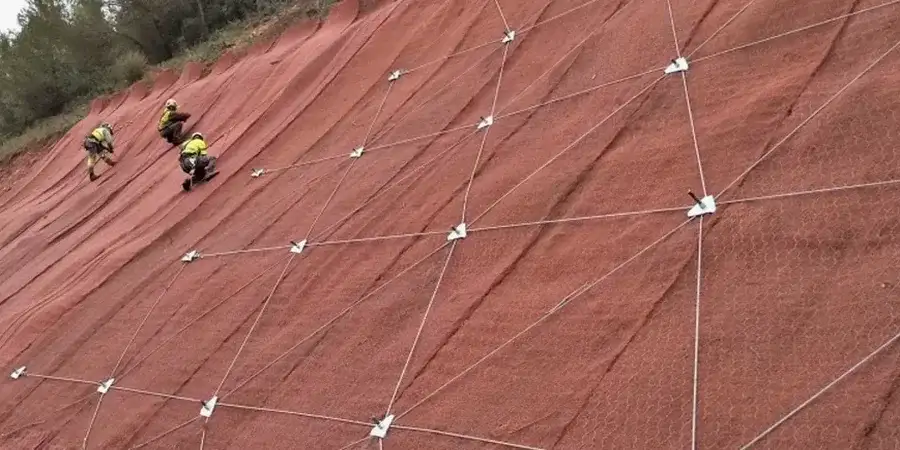
We reviewed a 35-foot cut on Bogus Basin Road where the contractor assumed the granite was massive. It was not. The upper 12 feet were decomposed grus with the consistency of coarse sand. A rain-on-snow event in February saturated the grus, pore pressure spiked, and the cut failed in a translational slide. The road was closed for four days. The fix required soil nailing and a shotcrete facing. That job cost six times more than the original earthwork budget. In Boise, the freeze-thaw cycle accelerates weathering in granitic rocks. The grus layer can be invisible from the surface. Boring logs without a slope stability analysis miss the mechanism entirely. Factor of safety calculations must account for transient seepage, not just steady-state flow.
Relevant standards
The analysis incorporates IBC 2024 (as adopted by Boise City with local amendments to Chapter 18), ASCE 7-22 for minimum design loads including the pseudo-static seismic coefficient for slope stability, ASTM D1586 for the Standard Test Method for SPT and Split-Barrel Sampling, ASTM D4767 for the Standard Test Method for Consolidated Undrained Triaxial Compression Testing, and the FHWA-NHI-05.
Other technical services
Preliminary desktop review
We pull USGS LiDAR, Boise geologic quadrangle maps, and historic landslides from the Idaho Geological Survey database. Deliverable: a memo with preliminary FoS estimates and recommended field program. Turnaround in 5 business days.
Full slope stability analysis with field investigation
Includes hollow-stem auger borings, Shelby tube sampling, inclinometer installation, and lab testing (CU triaxial, direct shear, Atterberg). We model static and pseudo-static conditions in Slide2. Final report with cross-sections and FoS tables.
Construction monitoring and inclinometer readings
Weekly or bi-weekly inclinometer readings during excavation. We plot displacement rate versus time and set trigger thresholds. If movement exceeds 0.1 inches per week, we issue a stop-work recommendation and design mitigation.
Typical parameters
Common questions
How much does a slope stability analysis cost for a Boise foothills project?
What factor of safety does Boise City require for permanent slopes?
Boise City follows IBC 2024, which requires a minimum static factor of safety of 1.5 for permanent slopes. Under seismic loading, using the ASCE 7-22 pseudo-static method with a horizontal coefficient kh appropriate for Boise's Site Class C or D, the minimum acceptable FoS is 1.1. We document both values in the geotechnical report with the critical failure surface shown in plan and section view.
Do you install slope inclinometers and read them during construction?
Yes. We install grouted-in-place inclinometer casing through the potential failure zone using a hollow-stem auger. Our field technician reads the casing with a bi-axial probe on a schedule we define in the instrumentation plan. We deliver displacement-versus-depth plots within 24 hours of each reading and flag any acceleration trend immediately.