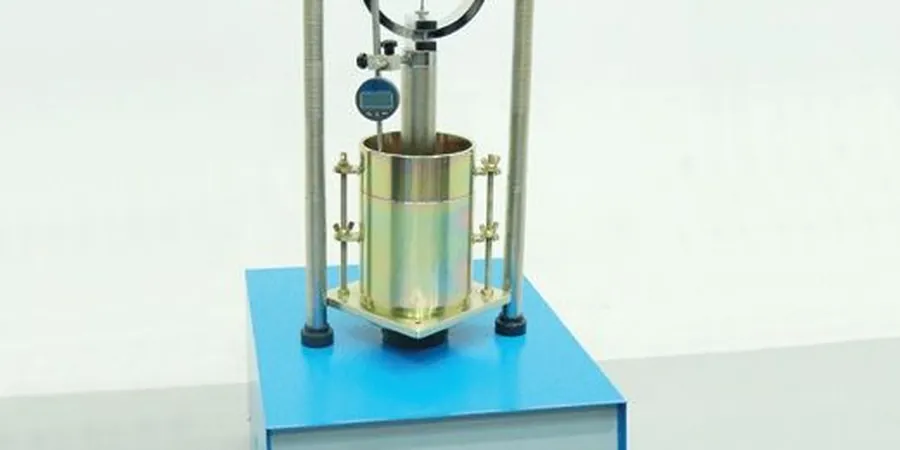
In the Treasure Valley, a lot of pavement failures we investigate come down to one thing: the subgrade wasn't tested right. Boise sits on a mix of Quaternary alluvial deposits from the Boise River, and the soil can shift from sandy gravel near the foothills to silty clay in the lower benches within a single block. That's where the laboratory CBR test becomes critical. It gives us the soaked bearing value of your compacted subgrade, which dictates pavement thickness. When we run a soaked CBR sample, we are simulating the worst-case scenario—spring thaw conditions when the water table rises and the soil loses strength. We run the test per ASTM D1883 and AASHTO T-193 in our accredited lab, so the numbers you get will hold up under review by the local highway district. For projects near the Boise Airport or along Federal Way, combining a CBR program with proctor compaction testing gives you the complete picture before you start laying down base course.
A soaked CBR test in Boise's silty soils is not a formality. It is the difference between a parking lot that lasts 20 years and one that fails in five.
Our approach and scope
Local ground factors
Boise's location on the northern edge of the Snake River Plain means we deal with loess deposits and slackwater silts from the Bonneville Flood. These soils are notorious for collapsing when they get wet, and a soaked CBR test is the only way to quantify that strength loss in the lab. If you skip the CBR and just go with a default structural number, you risk under-designing the asphalt or concrete section. We have pulled cores on commercial projects near Micron Technology's campus where the pavement section was half of what the traffic loading required, because the subgrade CBR was overestimated by the earthwork contractor. The repair cost was six figures. A proper laboratory CBR test costs a fraction of that and gives your civil engineer the data to defend the pavement design to the owner and the city inspector.
Relevant standards
The testing protocol incorporates AASHTO T-193, Standard Method of Test for CBR of Laboratory-Compacted Soils; ASTM D1883, Standard Test Method for CBR of Laboratory-Compacted Soils; and ASTM D698/D1557, Standard Test Methods for Laboratory Compaction Characteristics.
Other technical services
Soaked CBR Testing
Full 96-hour soak per AASHTO T-193 with load-penetration curve, corrected CBR at 0.1" and 0.2" penetration, and swell measurement.
Compaction Curve Development
Standard or Modified Proctor to establish maximum dry density and optimum moisture for your Boise site soil before CBR specimen preparation.
Stabilized Subgrade CBR
Test the CBR of lime, cement, or fly-ash treated soils to verify strength gain for poor native material in North Boise or Eagle foothills.
Pavement Design Support
CBR-based structural number calculation per AASHTO 1993 for flexible and rigid pavement sections on commercial and residential projects.
Typical parameters
Common questions
How much does a laboratory CBR test cost in Boise?
Why do you soak the CBR sample for four days?
The 96-hour soak simulates the worst moisture condition your subgrade will see over the pavement's life. In Boise, with our cold wet winters and high groundwater in lower-elevation areas near the river, a soaked CBR value gives the conservative design number that prevents premature rutting and cracking.
How many CBR samples do I need for my Boise project?
We recommend at least one CBR test per distinct soil type encountered in your geotechnical borings. For a typical commercial lot in Boise, that means three to five samples. Larger projects, like subdivisions or warehouse parks, may need more to capture the variability of the alluvial deposits across the site.