Boise grew up fast. The shift from a quiet agricultural valley to one of the fastest-growing metros in the Mountain West put serious pressure on local earthwork contractors. Subdivisions replaced orchards, and commercial pads rose on what used to be irrigation land. We saw it firsthand from the lab. The Treasure Valley sits on a mix of Quaternary alluvial deposits, river terrace gravels, and silty overbank soils, which means compaction behavior changes block by block. On a 100-degree July afternoon near the Boise River, getting a reliable field density number isn't just about the test method. It's about knowing how the local sandy silt reacts when it's bone dry and how much water you need to bring it back to optimum. Our sand cone gear gets calibrated for these exact conditions. Before placing structural fill, we often review subsurface data from test pits to confirm the native material classification, which directly affects compaction specs.
A clean sand cone test in Boise means the difference between a passed lift and a ripped-out fill on a Friday afternoon.
Our approach and scope
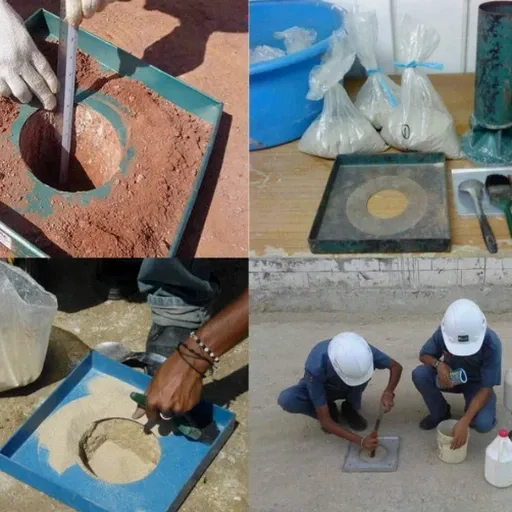
Local ground factors
The field kit itself is simple: a graduated plastic jar, a metal cone with a valve, a base plate, and a bag of standardized silica sand. But in Boise's summer heat, that plastic jar sits in the truck bed and can warp if you're not careful. A warped jar means the sand flow pattern changes, and your calibration is shot. We double-check the jar threads and the valve action before every test sequence. The other risk that contractors overlook is vibration from nearby equipment. A loaded scraper passing ten feet away will densify the sand in the jar, throwing off the mass measurement. We move the equipment back, set up on stable ground, and keep the test zone clear. When a lift fails, we don't just report the number. We talk to the foreman about moisture conditioning, roller type, and lift thickness adjustments, so the re-test goes green.
Relevant standards
The applicable standards for this testing protocol include ASTM D1556-15e1 for in-place density and unit weight of soil via the sand-cone method, ASTM D698-12e2 for laboratory compaction characteristics (Standard Proctor), AASHTO T-191 for in-place soil density by the sand-cone method, and IBC 2021 Section 1803.5.6 for verification of compacted fill material.
Other technical services
Structural Fill Compaction Testing
Sand cone density verification for building pads, parking lots, and retaining wall backfill across Ada County, following the project's approved compaction curve.
Utility Trench Backfill Verification
Lift-by-lift density checks in sewer, water, and storm drain trenches, where confined space conditions require careful test setup and rapid moisture readings.
Re-test and Compaction Troubleshooting
When a lift falls below spec, we provide practical guidance on moisture adjustment, roller pass count, and material blending to get the next lift passing clean.
Typical parameters
Common questions
How much does a sand cone field density test cost in Boise?
Why use the sand cone instead of a nuclear gauge for compaction testing?
The sand cone method is a direct volumetric measurement and doesn't require a radioactive source license. In Boise's mixed alluvial soils, where gravel lenses can throw off nuclear gauge readings, the sand cone gives a more reliable density value, especially in trench backfill with coarse material near the sides.
How long does a field density test take on site?
A single test, from setup to result, runs about 15 to 20 minutes. The excavation, sand filling, and moisture reading happen on the spot. If we're running multiple tests on the same lift, the pace picks up because the calibration is already dialed in for that material.
What do you need from the contractor to run the test properly?
We need a compacted lift ready for testing, a level area for the base plate, and a few minutes free from heavy equipment traffic. It helps to have the project's proctor curve on hand so we can compare dry density immediately and tell the foreman whether the lift passes or needs rework.