Boise sits on a complex mix of Quaternary alluvium and basalt flows from the Boise foothills. The water table sits high in the lower valley. We see it at 8 to 15 feet in much of the Treasure Valley. That means soft silts and loose sands dominate the upper soil profile. Stone column design becomes a primary ground improvement strategy here. The Boise River floodplain deposits are prone to settlement under structural loads. Liquefaction is a real concern in seismic events. The 2020 M6.5 Stanley earthquake reminded everyone. We use MASW surveys to map VS30 values across the site before any column layout. The subsurface data feeds directly into the column grid. We pair that with CPT testing to get continuous tip resistance and sleeve friction profiles in the loose sand layers.
A stone column grid is not just vertical drains. It is a reinforced soil mass. The columns and the native soil work together as a composite block under Boise's seismic loads.
Our approach and scope
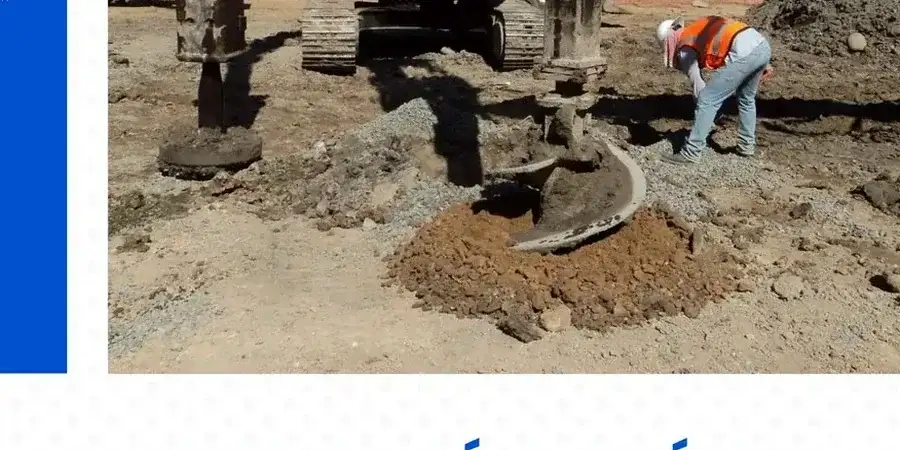
Local ground factors
The Treasure Valley has two distinct soil problems. The first is the loose sand lenses at 10 to 25 feet depth. These are liquefiable under the design earthquake. The second is the compressible silty clays in the old river channels. A standard shallow footing on these soils risks 3 to 4 inches of total settlement. Differential settlement cracks the slab and binds the doors. Stone columns mitigate both. The vibro-replacement process densifies the sand. It also reinforces the cohesive layers through compaction and drainage. We calculate the post-treatment settlement using the Priebe method. The factor of safety against liquefaction jumps from 0.6 to 1.3 or better. That is the difference between a total loss and a serviceable structure. Boise's climate adds another factor. The irrigation season saturates the upper soils every summer. High groundwater reduces the effective stress during construction. We account for that in the installation sequence and the pre-wetting of the aggregate.
Relevant standards
The design and ground improvement methodology adheres to FHWA-NHI-16-027 (Ground Improvement Manual), ASTM D1586-18 (Standard Penetration Test), ASTM D2487-17 (Unified Soil Classification), ASCE 7-22 (Minimum Design Loads), and IBC 2021 Chapter 18 (Soils and Foundations).
Other technical services
Pre-production testing
We run SPT borings and CPT soundings to map the target layers. The geotechnical report defines the column length, diameter, and grid spacing based on the lab consolidation and strength data.
Stone column installation
Wet top-feed and dry bottom-feed methods available. We handle the aggregate logistics, the water management, and the real-time QA/QC with digital data loggers on each rig.
Post-treatment verification
Modulus load tests on single columns and groups of three. We also run post-treatment CPTs between the columns to confirm the densification and the composite shear strength improvement.
Typical parameters
Common questions
What does stone column design cost for a typical Boise commercial building?
How do you verify the stone columns are working in Boise's sandy soils?
We run a modulus load test. A hydraulic jack pushes a steel plate over the column. We measure deflection at the top. The load-settlement curve tells us the column stiffness. We also push CPT soundings between the columns. The tip resistance should increase by 40 to 60 percent compared to the untreated soil.
Can stone columns replace deep foundations in the Treasure Valley?
Yes, in many cases they can. If the competent bearing stratum is deeper than 30 feet, piles make more sense. But for a 2 to 4 story building on Boise's alluvial soils, a stone column grid under a rigid mat foundation often eliminates the need for driven piles. It handles both the settlement and the liquefaction risk.