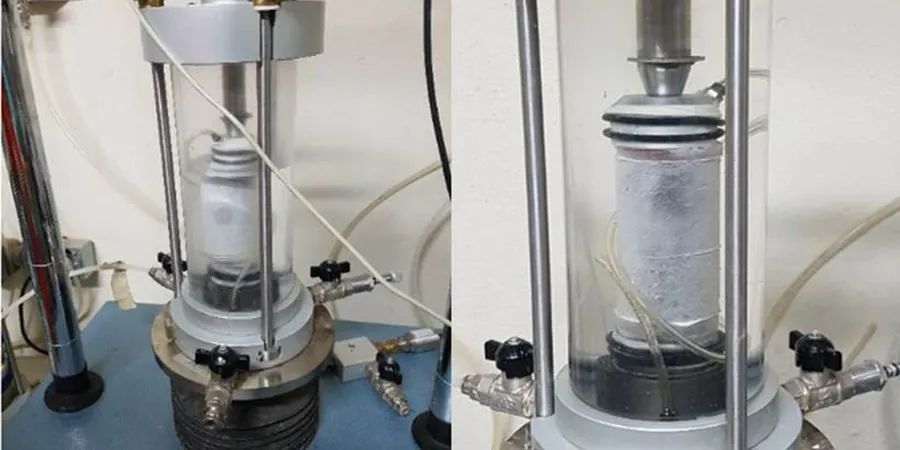
Boise sits in the Treasure Valley, where the Boise River cut deep terraces through ancient lake deposits. The dry climate allows silt-dominated soils to form a porous, honeycomb structure. When these soils get wet, the grains collapse and the ground suddenly settles. This is the hallmark of collapsible soils. For any builder planning a foundation, retaining wall, or road in Boise, a proper collapsible soil evaluation is not optional. It is the only way to anticipate how the ground will behave after the first heavy rain or irrigation cycle. The local geology makes this a priority for new development on the Bench or in the Foothills. Without testing, you risk differential settlement that cracks slabs and distorts frames. Pairing field investigation with laboratory consolidation tests gives engineers the data they need to predict collapse potential accurately. The team follows ASTM D5333 to simulate wetting under load.
A collapse index above 2 percent under wetting means the soil is collapsible. Ignoring it guarantees differential settlement under Boise's seasonal moisture cycles.
Process overview
Local context
Compare the North End against the West Bench. Both sit on the same Pleistocene terrace deposits. Yet the North End has thick, wind-blown loess that is highly collapsible. The West Bench has denser alluvial layers with lower collapse potential. A single home on the North End may settle 4 inches after one wet spring. A warehouse on the West Bench might see less than half an inch. That difference is the reason collapsible soil evaluation in Boise must consider micro-location. A generic test from a distant city is useless. The evaluation must be site-specific, depth-specific, and moisture-specific. The risk is not just settlement. It is tilted floors, cracked basement walls, and broken utility lines. And it happens fast. Collapse can occur within hours of saturation. For Boise builders, the evaluation is the cheapest insurance against a catastrophic callback.
Reference standards
ASTM D5333-20 (Collapse Potential of Soils), ASTM D2487-17 (Unified Soil Classification), ASTM D2435-20 (One-Dimensional Consolidation Properties)
Additional services
Undisturbed Sampling
Shelby tube and block sampling to preserve the natural soil structure for collapse testing.
Oedometer Collapse Test
Step-loading with controlled wetting per ASTM D5333 to measure the collapse index at design pressure.
Collapse Settlement Analysis
Calculates total and differential settlement under wetting based on layer thickness and collapse index.
Mitigation Recommendations
Advises on pre-wetting, deep compaction, or over-excavation to reduce collapse risk before construction.
Typical parameters
Quick answers
What makes Boise soils collapsible?
Boise's collapsible soils are mostly silty loess deposited by wind during the Pleistocene. The silt particles form a loose, open structure held together by clay bridges. When water breaks those bridges, the skeleton collapses. The dry climate preserves this metastable structure. Even moderate rainfall or irrigation can trigger sudden settlement.
How much does collapsible soil evaluation cost in Boise?
A standard evaluation for a single-family lot ranges from US$860 to US$2,500. This includes undisturbed sampling, two to three oedometer collapse tests, classification, and a written report. Larger commercial sites with multiple borings and deeper testing fall at the upper end. The final cost depends on the number of samples and the depth of investigation.
Can I build on collapsible soil without remediation?
Technically yes, but only if you design the foundation to tolerate differential settlement. In Boise, most codes require collapse mitigation for new structures. Common methods include pre-wetting the soil, deep dynamic compaction, or over-excavating the collapsible layer and replacing it with engineered fill. Skipping remediation almost always leads to cracked slabs and misaligned doors.
How deep does the collapsible layer extend in Boise?
It varies by location. On the Boise Bench, collapsible loess can extend 10 to 25 feet deep. In the Foothills, the depth is shallower, often 6 to 12 feet, but the collapse index tends to be higher. The evaluation must sample at multiple depths because the most collapse-prone layer may be several feet below the surface. A single shallow sample is not enough.