Boise grew fast after the 1970s. The city pushed into the foothills and the Boise River floodplain. That meant building on silty sands, gravelly terraces, and old river deposits. MSE wall design became essential for these slopes. A mechanically stabilized earth wall handles differential settlement better than a rigid concrete wall in Boise's variable alluvium. Before we design the reinforcement layers, we always run a densidad-cono-arena to verify the compaction of the backfill zone. That data tells us the friction angle we can use in the internal stability analysis. We also check the foundation bearing capacity with a placa-de-carga test on site. For walls higher than 6 meters, we add a corte-directo on representative soil samples to refine the shear strength parameters. Every MSE wall we design in Boise starts with these field verifications.
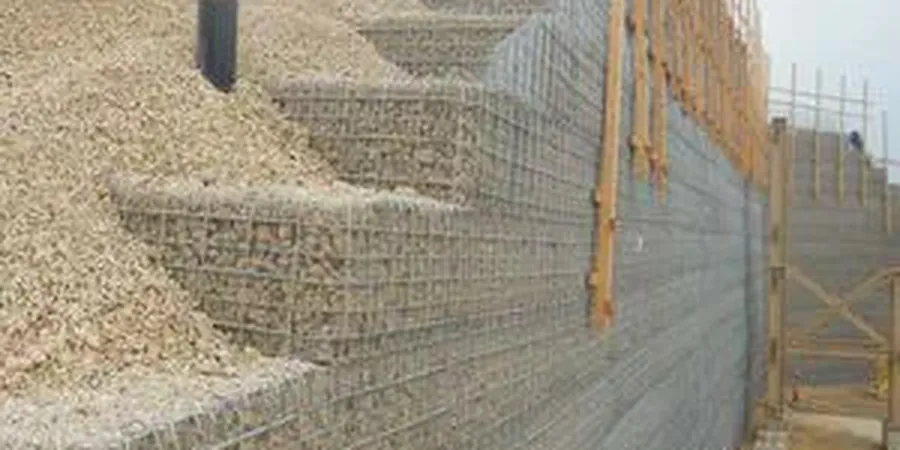
Silty sand near the Boise River can drop to 28 degrees friction angle. Field testing before design prevents wall failures.
Process overview
Local context
Compare two Boise neighborhoods: the Bench and the North End. The Bench sits on old lakebed silts with high collapse potential. The North End has sandy gravel with good drainage. A poorly designed MSE wall on the Bench can settle 50 mm more than one in the North End. That difference cracks the facing panels and tilts the wall. The biggest risk in Boise is water. The water table rises in spring. If the drainage aggregate behind the wall clogs, hydrostatic pressure builds and pushes the wall forward. We always install a 300 mm thick drainage blanket with a perforated pipe at the base. We also specify a geotextile filter to prevent fines migration from the native soil into the drain rock. Without that, the wall fails within five years.
Reference standards
AASHTO LRFD Bridge Design Specifications 9th Edition (2020) – Section 11, IBC 2021 – Section 1807: Retaining Walls, ASTM D6638-18: Standard Test Method for Determining Connection Strength Between Geogrid and Segmental Concrete Units, FHWA-NHI-10-024: Mechanically Stabilized Earth Walls and Reinforced Soil Slopes Design & Construction Guidelines, ASTM D5321-20: Standard Test Method for Determining the Coefficient of Soil and Geosynthetic Friction
Additional services
MSE Wall Geotechnical Investigation
We drill boreholes, run SPT tests, and collect undisturbed samples from the wall alignment. The lab tests include direct shear, triaxial, and compaction characteristics. We deliver a site-specific design report with recommended friction angles, soil unit weights, and bearing capacities. This service covers walls up to 15 meters high.
MSE Wall Internal & External Stability Analysis
We model the wall using limit equilibrium software. We check internal stability for each geogrid layer, external stability for sliding and overturning, and global stability for the entire slope. We produce reinforcement schedules, connection strength requirements, and drainage specifications. The output includes a stamped calculation package for permit approval.
Typical parameters
Quick answers
What is the difference between an MSE wall and a conventional retaining wall in Boise?
An MSE wall uses soil reinforcement with geogrids or steel strips to create a stable composite mass. A conventional gravity or cantilever wall resists earth pressure with its own weight or a base slab. In Boise's loose sands and silts, MSE walls handle differential settlement better. They also cost less for heights above 4 meters. We typically recommend MSE walls for slopes where the retained height exceeds 6 meters.
How much does an MSE wall design for a Boise residential project cost?
For a typical residential MSE wall up to 6 meters high and 30 meters long, the geotechnical investigation and design report ranges between US$1,310 and US$4,620. The final cost depends on the number of borings required and whether seismic analysis is needed. We provide a fixed-price quote after reviewing the site access and wall geometry.
Do I need an MSE wall design for a slope in the Boise foothills?
Yes. The Boise foothills have colluvial soils with variable strength and hidden boulders. An unreinforced slope cut can fail during wet winters. An MSE wall stabilizes the cut and creates usable flat land. We have designed walls for several foothills projects where the native soil friction angle ranged from 26 to 32 degrees. The design must account for seasonal water infiltration.
What is the typical lifespan of an MSE wall in Boise's climate?
A properly designed and constructed MSE wall in Boise lasts 50 to 75 years. The key factors are drainage and geogrid durability. We specify geogrids with a UV stabilizer and a design life of 120 years per ASTM D5262. The facing panels need a proper drainage system to prevent freeze-thaw damage. Boise gets about 30 freeze-thaw cycles per year, so we also detail a drainage outlet at the lowest panel joint.