Boise grew fast along the Boise River floodplain, where old river channels left a patchwork of sands, silts, and gravels. Later development pushed into the foothills, exposing colluvial soils and decomposed granite. These variable ground conditions make geocell design especially valuable. A three-dimensional cellular confinement system locks granular fill in place, spreads vertical loads, and resists lateral movement. Before specifying the cell geometry or infill material, we run a soil resistivity survey to map subsurface variability, and we often pair it with a plate load test to calibrate the bearing capacity for the actual site conditions. That way the geocell system is designed for the real ground, not a textbook assumption.
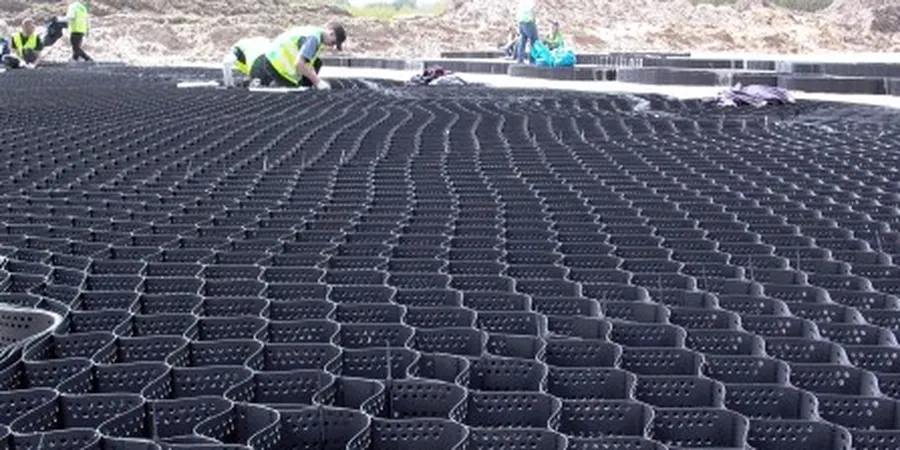
Geocell design in Boise must account for both collapsible silts in the valley and shallow bedrock in the foothills within the same project.
Process overview
Local context
The difference between a site near the Boise River and one in the North End foothills is stark. In the valley, geocell often sits on loose silty sands with a high liquefaction potential during a seismic event. The cell confinement reduces lateral spreading but does not eliminate it. In the foothills, the problem is the opposite: shallow basalt or weathered granite creates a rigid boundary that can punch through the geocell if the infill is not well graded. We address this by specifying a thicker base layer (300 mm cells) on the valley side and a geogrid reinforcement layer below the geocell on the foothill side. Every design is checked against the actual soil profile from a test pit or SPT boring.
Reference standards
IBC 2021 (Chapter 18 – Soils and Foundations), ASCE 7-22 (Seismic Loads & Site Class), ASTM D6992 (Creep Reduction Factors for Geosynthetics), AASHTO M 288 (Geotextile Specification), ASTM D4884 (Seam Strength for Geocell)
Additional services
Slope & Retaining Wall Reinforcement
Geocell facing for steep slopes (up to 1H:1V) with internal drainage layers. We design the cell depth and connection type so the wall resists overturning and sliding without external tiebacks.
Load Support Platforms for Access Roads & Laydown Areas
For soft subgrades (CBR 1–3) we design a geocell-reinforced aggregate section that reduces the required fill thickness by 40–60% compared to unreinforced granular layers.
Erosion Control on Steep Cut/Fill Slopes
Geocell filled with topsoil or gravel to stabilize embankments along Boise's foothill subdivisions. Infill selection and cell size are optimized for the local rainfall intensity and drainage patterns.
Typical parameters
Quick answers
What site data do you need for a geocell design in Boise?
We require a soil profile (from test pits or SPT borings), the subgrade CBR or resilient modulus, the design traffic load, and the slope geometry. For seismic designs we also need the site class per ASCE 7.
How much does geocell design cost in Boise?
The typical range for a complete geocell design report is US$710 to US$2,460, depending on the number of cross sections, the complexity of the soil profile, and whether laboratory testing is needed.
Can geocell replace a traditional retaining wall?
Yes, for walls up to about 4 m in height, a geocell-faced slope can be a cost-effective alternative. It requires more footprint but less structural reinforcement. We always check global stability with a limit-equilibrium analysis.
What infill material works best for Boise soils?
Clean, angular gravel (AASHTO No. 57 or No. 67) provides the highest friction angle. When gravel is scarce, we allow crushed concrete or recycled asphalt provided it passes a direct shear test and a freeze-thaw durability test.