Boise sits at an elevation of 2,730 feet along the Boise River, underlain by deep alluvial deposits from the Pleistocene era. Driven pile design here must account for the variable sand and gravel layers interbedded with silty clay. We routinely encounter refusal conditions in the cobble-rich strata near the river, which demand careful hammer energy calibration. Before specifying a pile type, we cross-check the soil profile with a MASW-Vs30 survey to map shear-wave velocities down to 30 meters. This is not theoretical work; it is the daily reality of building in the Treasure Valley's floodplain. Our approach integrates dynamic testing and wave equation analysis to match the pile section to the driving resistance found on site.
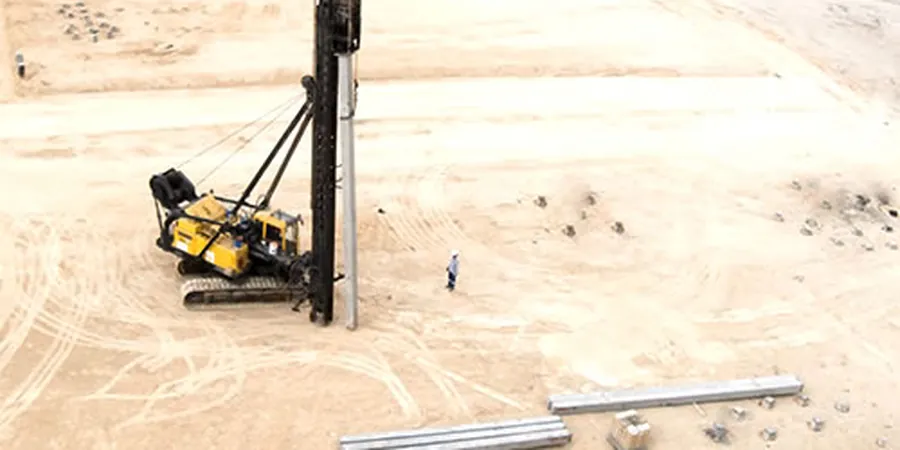
In Boise's alluvial soils, driven pile capacity often doubles after 14 days of setup — ignoring this can waste over 30% of foundation cost.
Process overview
- Borehole logging per ASTM D1586-18 with SPT N-values every 1.5 m
- Soil classification by ASTM D2487-17
- Pile dynamic analysis using CAPWAP and PDA
- Static load test to 200% of design load per ASTM D1143-20
Local context
The most common risk in Boise driven pile design is underestimating the refusal depth in the Boise River gravels. We have seen contractors mobilize a D30-32 hammer expecting 15 m penetration, only to hit cobble at 6 m. That mismatch can delay a project by weeks. Our pre-construction risk assessment includes a borehole camera survey to document cobble size and distribution. For sites near the Foothills, we also evaluate the risk of pile damage from basalt floaters. We recommend a sacrificial steel shoe on H-piles and a minimum wall thickness of 12 mm for pipe piles. The cost of a restrike program is trivial compared to a failed pile foundation.
Reference standards
IBC 2021 Chapter 18 – Soils and Foundations, ASCE 7-22 Section 12.13 – Seismic Design for Deep Foundations, ASTM D1586-18 – Standard Test Method for Standard Penetration Test, FHWA-NHI-16-009 – Design and Construction of Driven Pile Foundations, ASTM D1143-20 – Standard Test Methods for Deep Foundations Under Static Axial Compressive Load
Additional services
Pile Dynamic Testing and Analysis
We perform PDA testing with an embedded strain transducer and accelerometer per ASTM D4945-17. Our analysis uses CAPWAP software to compute total capacity, skin friction distribution, and end bearing. We also provide restrike testing 14 days after initial driving to capture setup effects. This service is essential for verifying design assumptions on Boise projects where gravel layers cause variable driving resistance.
Static Load Test Design and Supervision
We design and supervise static axial compression tests per ASTM D1143-20, using the Quick Test method with a reaction beam anchored by adjacent piles. Our team installs telltales at the pile toe and strain gauges along the shaft to separate skin friction from end bearing. For Boise sites, we recommend a maintained-load test to 200% of design load, with 30-minute hold intervals to capture creep behavior in the clayey silts.
Typical parameters
Quick answers
What is the typical driven pile capacity range in Boise's alluvial soils?
For steel H-piles (HP 12x53) driven through the Boise River gravels into dense sand, we typically see ultimate capacities between 150 and 350 tons. In the clayey silt units near the Airport, capacities are lower — around 80 to 120 tons — and setup effects become critical. We always run a site-specific wave equation analysis before quoting capacity.
How much does a driven pile design study cost in Boise?
For a typical commercial project in Boise, a driven pile design study — including boreholes, SPT, PDA testing, and a design report — ranges between US$1.320 and US$4.410. The final cost depends on the number of test piles, depth of refusal, and whether a static load test is required. Contact us for a scope-specific quote.
Do I need a static load test for a driven pile foundation in Boise?
IBC 2021 requires a static load test when the factored design load exceeds 200 tons per pile, or when the site-specific soil variability is high. In Boise's alluvial environment, we often recommend at least two static load tests per building footprint even if not strictly required, because the gravel-cobble layers can mask weak pockets. The test validates both setup and structural integrity.
What seismic hazards affect driven pile design in Boise?
Boise lies within Seismic Design Category D per ASCE 7-22, with a mapped PGA of 0.37g for the 2% in 50-year event. The primary hazards are liquefaction in the saturated sands near the Boise River and lateral spreading on the low terraces. Our driven pile design checks for downdrag from liquefaction-induced settlement and includes a minimum of 3 m penetration into non-liquefiable strata.