A 20-ton pounder drops from 25 meters onto a grid marked across a dusty lot in Boise’s West Bench. The impact sends a visible shockwave through the gravelly sands and silts that dominate the Treasure Valley’s subsurface. This is dynamic compaction in action — a high-energy technique that densifies loose granular soils to depths of 6 to 10 meters without excavating. The crane mounted on a custom skid repeats the pattern across overlapping passes until the target density is verified by cone penetration tests and plate load checks. Before the tamper ever leaves the ground, the team models the drop energy, grid spacing, and number of passes using site-specific soil data from ensayo SPT borings to ensure the energy reaches the required depth without over-compacting the upper layers.
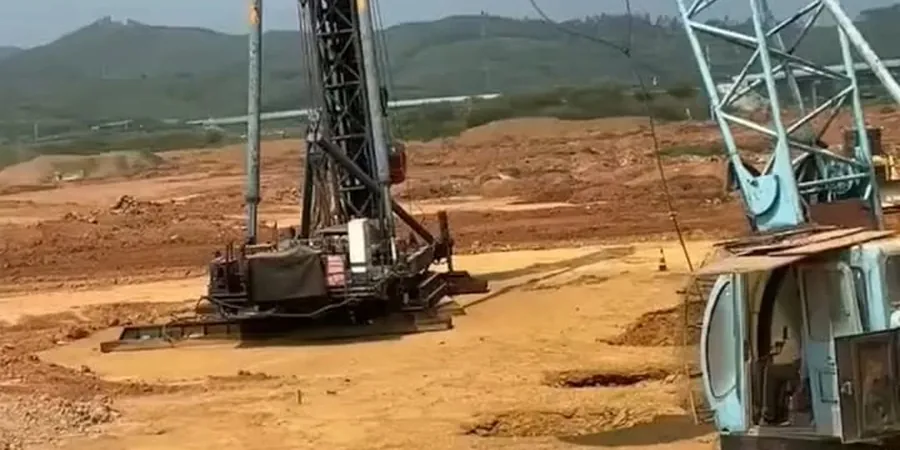
A single drop of a 25-ton weight can densify a 6-meter column of loose sand in less than a second — no excavation, no slurry, no delay.
Process overview
Local context
ASCE 7-22 requires site-specific ground motion parameters for any structure in Seismic Design Category C or higher, and Boise falls into SDC C for most of the valley. Loose, saturated sands beneath the water table — common near the Boise River — are susceptible to liquefaction under design earthquake shaking. Dynamic compaction directly addresses this risk by increasing relative density above the threshold where pore pressure buildup triggers liquefaction. The design must account for the fines content: soils with more than 15% passing the #200 sieve may not respond to dynamic compaction alone. In those cases, the team pairs the tamper program with wick drains or stone columns to provide drainage paths and accelerate post-compaction dissipation. The NCEER (1997) and Youd-Idriss (2001) methods are used to estimate post-treatment cyclic resistance ratios and verify that the target factor of safety against liquefaction reaches at least 1.3 under the MCE ground motion.
Reference standards
ASCE 7-22 — Minimum Design Loads and Associated Criteria for Buildings, IBC 2021 — Chapter 18: Soils and Foundations, ASTM D1586-18 — Standard Test Method for Standard Penetration Test (SPT), NCEER (1997) — Evaluation of Liquefaction Resistance of Soils
Additional services
Feasibility & Soil Screening
Review of existing geotechnical reports, SPT logs, and grain size distribution to confirm that the site's soils are suitable for dynamic compaction. We model energy attenuation using Menard's formula and recommend alternative methods if fines exceed 20% or groundwater is too shallow.
Field Program Design & QA/QC
Development of drop weight, fall height, grid spacing, and pass sequence tailored to Boise's alluvial stratigraphy. We supervise the first drop sequence, monitor crater depth and ground vibrations in real time, and perform post-treatment CPT or SPT to verify density gains. A final report documents the as-built treatment and certifies compliance with project specifications.
Typical parameters
Quick answers
How much does dynamic compaction design cost in Boise?
The design and field supervision typically costs between US$1.160 and US$4.020 depending on site area, number of passes, and required verification testing. This includes the initial feasibility analysis, drop program design, on-site monitoring during compaction, and post-treatment testing with a final report.
What soil types are best suited for dynamic compaction in the Treasure Valley?
Dynamic compaction works best on granular soils — sands, gravels, and cobbles with less than 15% fines passing the #200 sieve. Boise's alluvial fans from the Foothills and the Boise River terraces are ideal. Clayey silts or organic-rich layers in low-lying areas near the river require alternative methods like stone columns or deep soil mixing.
How deep can dynamic compaction improve the soil in Boise?
Effective improvement depth typically ranges from 5 to 10 meters, controlled by the product of drop weight and fall height (W x H). For a 25-ton weight dropped from 25 meters, the Menard formula predicts an improvement depth of about 8 meters. Deeper treatment requires a heavier pounder or a second pass with longer fall height after the upper layer stiffens.