Boise sits on a mix of alluvial silts and sands from the Boise River floodplain, with shallow groundwater in many low-lying areas. For rigid pavement design, this means careful evaluation of subgrade support and drainage. The frost susceptibility of Boise’s silty soils also demands a proper base layer to prevent heave. We follow ASTM D1586 for SPT sampling and AASHTO T-190 for resilient modulus testing to characterize the subgrade. In areas with soft layers, a subrasante vial treatment can improve bearing capacity before placing the slab. The typical design life we target in Boise is 20 to 30 years for municipal streets, accounting for freeze-thaw cycles and occasional heavy truck loads.
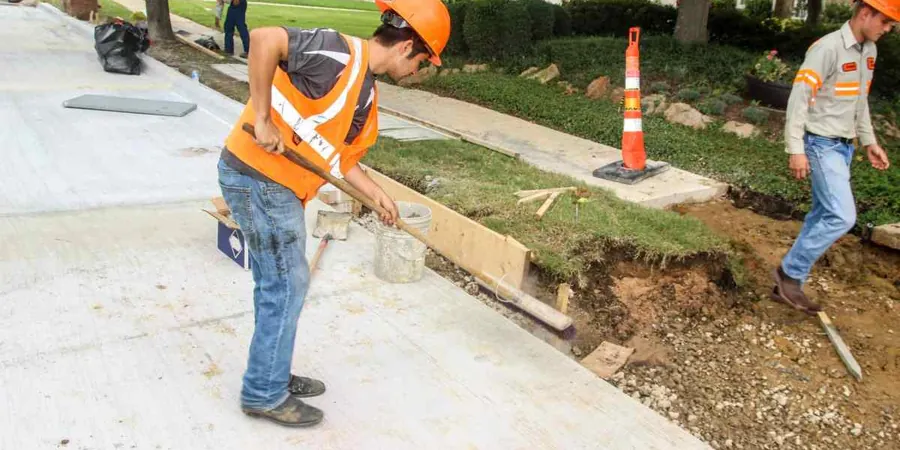
Freeze-thaw cycles in Boise demand a rigid pavement design that accounts for subgrade frost susceptibility and proper joint spacing to control cracking.
Process overview
Local context
Boise experiences over 90 freeze-thaw cycles annually, which can cause slab heave and cracking if the subgrade is poorly drained. Silty soils in the Bench area are particularly prone to ice lens formation. Without proper drainage and a thick granular base, water accumulates beneath the slab and weakens support. Seismic shaking can also induce differential settlement in liquefiable sands along the river corridor. Our rigid pavement design includes a drenaje vial strategy with edge drains and a permeable base layer to evacuate water quickly, reducing the risk of pumping and joint faulting.
Reference standards
ASTM D1586 (SPT sampling), AASHTO Guide for Design of Pavement Structures (1993/2020), IBC 2021 Seismic Provisions for Boise
Additional services
Subgrade Investigation & Testing
Boreholes, SPT, and plate load tests to determine soil modulus and bearing capacity per ASTM standards.
Concrete Mix Design & Verification
Flexural strength testing (ASTM C78) and durability assessments for freeze-thaw resistance.
Drainage & Base Course Design
Permeability testing and granular layer thickness optimization to prevent water accumulation under slabs.
Typical parameters
Quick answers
What is the typical cost for rigid pavement design in Boise?
For a standard commercial or municipal project, the geotechnical investigation and design typically ranges between US$1,800 and US$6,230, depending on subgrade variability, number of test pits, and required laboratory testing.
How does Boise's freeze-thaw climate affect rigid pavement design?
Frequent freeze-thaw cycles demand a non-frost-susceptible subgrade and a well-drained base course. We use a minimum 12-inch granular base and specify air-entrained concrete to resist scaling.
Do I need a seismic check for rigid pavement in Boise?
Yes. Boise is in IBC Seismic Design Category C, so we evaluate liquefaction potential in sandy soils and design joints to accommodate lateral spreading without loss of support.
What is the difference between rigid and flexible pavement for Boise roads?
Rigid pavement uses a concrete slab that distributes loads over a wider area, ideal for heavy truck traffic and low-maintenance surfaces. Flexible pavement uses asphalt layers and may require more frequent rehabilitation in Boise's climate.