Boise sits at 2,700 feet above sea level in the Treasure Valley, where the Boise River cuts through sediments that vary from cobble-rich terraces to silty floodplain deposits. These conditions demand retaining wall design that accounts for lateral earth pressures, perched water tables, and the region's moderate seismic risk. Our team approaches each project with site-specific soil data — we do not rely on generic assumptions. Before specifying a wall type, we run laboratory tests to classify the soil and measure shear strength. For cohesive materials we often require a consolidation test to evaluate settlement behind the wall. When the backfill is granular, the focus shifts to drainage and friction angle. Every design considers the wall height, surcharge loads, and long-term performance under Boise's freeze-thaw cycles.
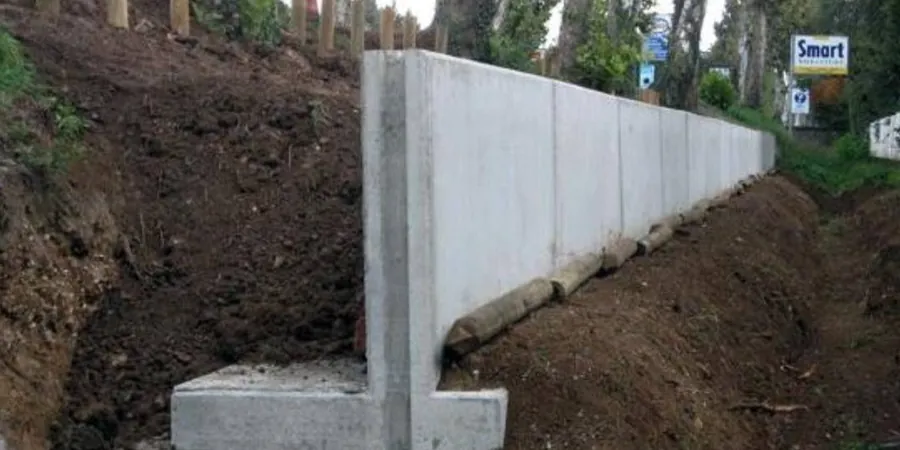
Retaining wall design in Boise must account for alluvial terrace deposits, perched water, and seismic accelerations that reach up to 0.3g under IBC Site Class D.
Process overview
Local context
A risk we frequently encounter in Boise is the presence of undocumented fill from older construction projects. These fills can be highly variable, containing debris, loose sands, or organic matter that settle unpredictably. If a retaining wall is built on or behind such material without proper investigation, differential movement is almost guaranteed. We always recommend a soil boring or test pit to identify fill depth and composition before finalizing the wall alignment. Another local issue is frost heave in silty soils — the frost depth in Boise reaches about 30 inches, so wall footings must sit below that line unless the backfill is free-draining gravel. Ignoring these factors leads to cracked walls and costly repairs within a few winters.
Reference standards
AASHTO LRFD Bridge Design Specifications (8th Edition, 2017), IBC 2021 — Chapter 18 (Soils and Foundations), ASTM D3080 / D4767 (Direct Shear / Triaxial Compression), ASCE 7-16 (Minimum Design Loads for Buildings)
Additional services
Gravity and Cantilever Wall Design
Concrete or masonry walls analyzed for overturning, sliding, and bearing pressure. We design the stem, footing, and drainage system per IBC and ACI 318. Suitable for heights up to 15 feet in residential and commercial projects.
Reinforced Soil Wall Design (MSE Walls)
Mechanically stabilized earth walls with geogrid or steel strips. We select reinforcement type, length, and spacing based on the retained soil properties and surcharge loads. Common in Boise's highway and subdivision projects.
Tieback and Anchored Wall Design
For deep excavations or constrained sites, we design anchored systems with grouted tendons and shotcrete or soldier piles. Each anchor is proof-tested to 133% of design load per PTI recommendations.
Typical parameters
Quick answers
What soil parameters do you need for retaining wall design in Boise?
We need the soil's friction angle, cohesion, unit weight, and groundwater depth. These are obtained through direct shear or triaxial testing on undisturbed samples from the site. We also run a sieve analysis to classify the soil per ASTM D2487.
How much does retaining wall design cost in Boise?
The typical range for a residential or small commercial wall design is between US$1,080 and US$4,620, depending on wall height, soil complexity, and the number of design iterations required. This includes soil testing, calculations, and a sealed report.
Do I need a geotechnical report before designing a retaining wall?
Yes. Without a geotechnical report, you cannot verify bearing capacity, lateral earth pressures, or drainage requirements. Many Boise contractors have faced wall failures because they skipped this step. We recommend at least one soil boring per 50 feet of wall length.