In Boise, many projects along the Boise River encounter soft lacustrine clays and silts that don't hold together well in a conventional sampling tube. That is where the field vane shear test (VST) becomes essential. Instead of relying on disturbed samples, we insert a four-bladed vane directly into the soil at the base of a borehole and rotate it to measure the peak and remolded shear strength. This test captures the true undrained strength of cohesive soils. It is especially useful for embankments, excavations, and shallow foundations where stability depends on the clay's intact resistance. The VST works rapidly in the field and the data feeds directly into bearing capacity or slope stability calculations. Before starting a foundation design, combining the VST with a study of slope stability gives a clearer picture of how soft soils behave under load.
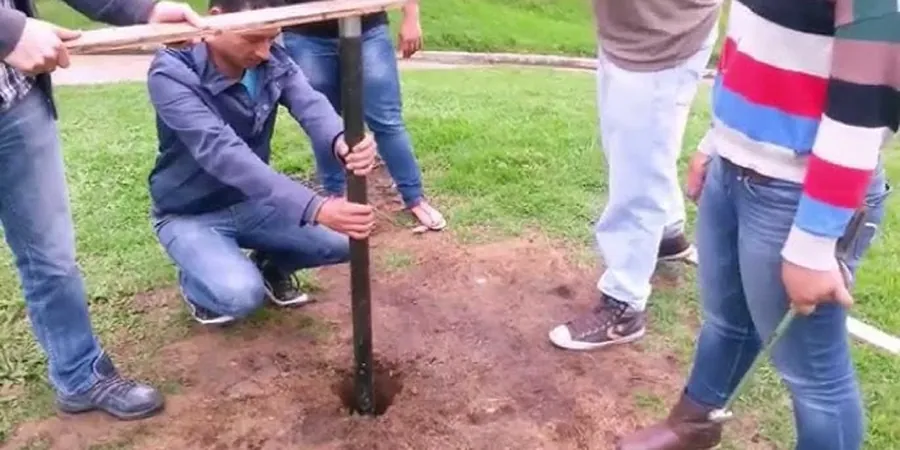
The VST captures undrained shear strength in soft Boise clays where undisturbed sampling often fails. It is fast, reliable, and directly applicable to foundation and slope design.
Process overview
Local context
A common mistake in Boise construction is assuming that all clay behaves the same. Without a field vane shear test, contractors often overestimate the undrained strength of soft lacustrine clays. That leads to undersized footings or excessive settlement. Another error is relying solely on lab tests from disturbed samples. Those samples lose their natural structure and fabric. The VST measures the clay in place, capturing the real shear strength including any fissures or macrofabric. Skipping this test on a site with soft clays can result in foundation failure, slope instability, or unexpected heave during excavation. The cost of a single VST is trivial compared to the cost of repairing a cracked slab or a failed retaining wall.
Reference standards
ASTM D2573-18 – Standard Test Method for Field Vane Shear Test in Saturated Fine-Grained Soils, ASTM D1586-18 – Standard Test Method for Standard Penetration Test (SPT) and Split-Barrel Sampling of Soils, IBC 2021 – Chapter 18, Soils and Foundations, ASCE 7-22 – Minimum Design Loads and Associated Criteria for Buildings and Other Structures
Additional services
Borehole VST (Standard)
Vane shear test performed at the base of a borehole advanced by auger or wash boring. Suitable for depths up to 30 m. Includes peak and remolded strength measurements at each test depth. Results reported in a tabular and graphical format with shear strength versus depth.
Downhole VST with Remote Torque Head
Advanced setup using a downhole torque transducer to eliminate rod friction errors. Ideal for deep tests or when rod friction is expected in cased boreholes. Provides cleaner torque readings and more accurate strength values.
Sensitivity Profiling (VST Series)
Multiple vane tests at closely spaced depth intervals to produce a continuous sensitivity profile. Includes both peak and remolded values. Useful for identifying quick clays or evaluating the effect of soil disturbance on foundation design.
Typical parameters
Quick answers
What is the field vane shear test used for in Boise?
The VST measures the undrained shear strength of soft to medium cohesive soils in place. In Boise, it is primarily used for foundation design on lacustrine clays, embankment stability analysis, and excavation support design. It provides a direct measure of the soil's intact strength without the disturbance caused by sampling and transport.
How does the VST compare to the unconfined compression test?
The VST tests the soil in its natural state at the borehole bottom, preserving the in-situ stress and fabric. The unconfined compression test uses a trimmed sample that has been disturbed and unloaded. For soft clays, the VST generally gives lower and more reliable strength values than unconfined compression on the same soil.
What is the typical cost of a field vane shear test in Boise?
The typical cost ranges between US$680 and US$1,370 per test, depending on depth, site access, and the number of tests required. This includes mobilization, vane insertion, torque measurement, and a certified report with shear strength values. Volume discounts apply for multiple test locations on the same site.
Can the VST be performed in gravelly soils?
No. The vane blade cannot penetrate gravel, cobbles, or dense sand. The test is only suitable for fine-grained cohesive soils such as clays and silts. In Boise, we pre-screen the borehole log to ensure the test depth falls within a clay layer before deploying the vane. If gravel is encountered, we switch to SPT or CPT methods.