A common mistake we see in Boise road projects is assuming the native volcanic ash and clay mix will compact uniformly without treatment. The Treasure Valley's soil profile is deceptive. It looks stable when dry but turns into a plastic, expansive nightmare after a spring thaw. Contractors who skip proper soil stabilization for roads end up with cracked pavements within two seasons. The fines content in Boise soils often exceeds 35 percent, which means standard compaction alone won't cut it. You need a chemical or mechanical intervention to control volume change and improve bearing capacity. Before placing any subbase, we run a full index property suite including Atterberg limits to classify the clay fraction. That data drives the stabilizer selection. For Boise's high-plasticity clays, lime or cement treatment is almost mandatory. A study of Atterberg limits tells us exactly how reactive the soil is. Without that step, you are guessing. And guessing on a municipal road means failures that cost three times more to fix later.
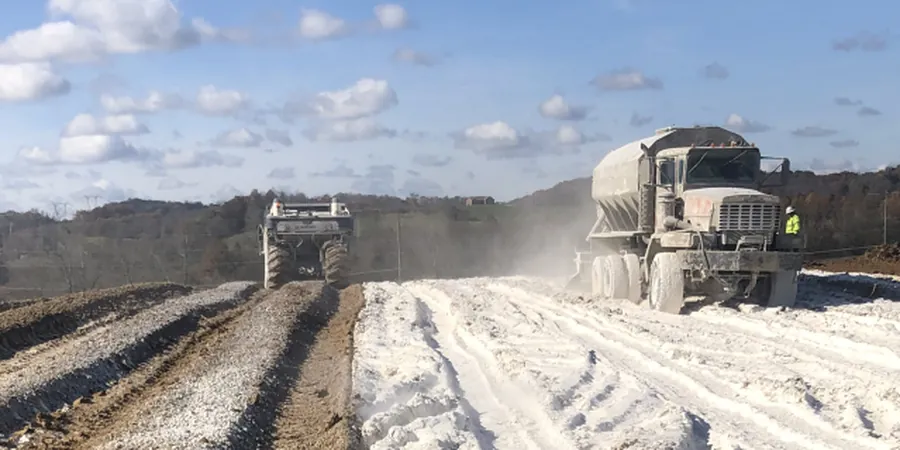
Boise's volcanic ash and expansive clays demand chemical treatment before road construction. Skipping stabilization guarantees pavement failure within two winters.
Process overview
- Plasticity index before and after treatment
- Optimum moisture content and maximum dry density (ASTM D698)
- Unconfined compressive strength after 7 days of curing
- CBR swell test at 96-hour soak
Local context
Boise sits on the western edge of the Basin and Range Province. The subsurface geology includes layers of volcanic tuff, basalt, and lacustrine clay deposited by ancient Lake Bonneville. This mix creates erratic soil conditions. A road cut can expose a stiff silt one meter down and a soft, wet clay the next. The risk of differential settlement is high. Without targeted soil stabilization for roads, you get longitudinal cracking and edge failures. The seasonal water table in the Boise River valley fluctuates up to 3 meters between winter and summer. That cyclic wetting and drying amplifies the shrink-swell potential. We have seen pavements lift 50 mm after a wet spring. The only reliable mitigation is a properly designed stabilization program that accounts for the local soil mineralogy and drainage patterns.
Reference standards
ASTM D4318 (Atterberg Limits), ASTM D698 (Standard Proctor), ASTM D1883 (CBR), AASHTO T-216 (Lime Treatment for Soils), IBC Chapter 18 (Soils and Foundations)
Additional services
Soil Classification & Index Testing
Full suite of grain size analysis, Atterberg limits, and natural moisture content to classify the subgrade per USCS and AASHTO.
Lime and Cement Dosage Design
Laboratory mix designs to determine the optimum additive percentage for PI reduction and strength gain, following AASHTO T-216 and ASTM D6276.
Moisture-Density Relationship
Standard and modified Proctor tests (ASTM D698 / D1557) to establish compaction targets for treated and untreated soils.
CBR and Swell Testing
Soaked and unsoaked California Bearing Ratio tests with swell measurement to evaluate subgrade support and volume change potential.
Typical parameters
Quick answers
What makes Boise soils different from other regions for road construction?
Boise's soils are a mix of volcanic ash, basalt fragments, and lacustrine clay from ancient Lake Bonneville. They have high plasticity and variable drainage. Standard compaction alone rarely produces a stable subgrade. Chemical stabilization with lime or cement is typically required to control swell and improve bearing capacity.
How much does soil stabilization for roads cost in Boise?
For a typical Boise road project, the cost ranges between US$830 and US$2,900 per test section depending on the number of samples, additive dosage design, and field verification. The final price depends on soil variability and the depth of treatment required.
How long does a lime treatment take to show results?
After mixing lime into the soil, the plasticity index drops significantly within 24 to 72 hours. Full strength gain for a lime-stabilized subgrade takes 7 to 28 days depending on temperature and moisture conditions. We run unconfined compression tests at 7 and 28 days to verify the design strength.
Do I need soil stabilization for every road project in Boise?
Not every project requires chemical treatment. If the subgrade has a plasticity index below 15 and a CBR above 10, mechanical compaction alone may be sufficient. We recommend a preliminary soil investigation with Atterberg limits and CBR testing to decide. The cost of testing is small compared to the cost of pavement failure.