The 2021 IBC and ASCE 7 require site-specific settlement analysis for any structure on fine-grained soils, and in Boise that rule hits hard. Our team runs the oedometer consolidation test per ASTM D2435 to measure pre-consolidation stress and compression index on undisturbed samples. Boise's alluvial terraces and lacustrine silts can show collapse potential under load, so we pair the consolidation data with a sieve analysis and Atterberg limits to classify the material correctly. The city's rapid growth means infill lots often sit on variable fill that needs careful one-dimensional compression curves before we recommend foundation depth. Without this test, post-construction settlement in Boise's mixed clay-silt layers can exceed tolerable limits in just a few years.
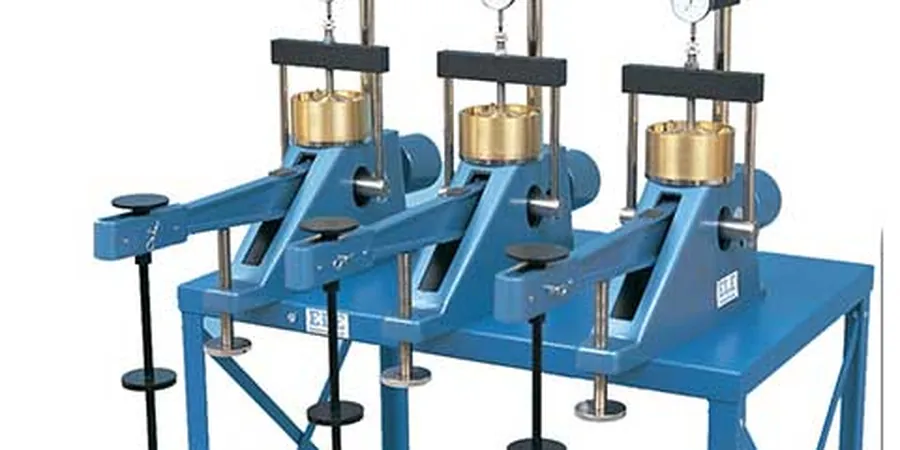
For Boise's alluvial silts, pre-consolidation stress from the oedometer test directly dictates whether we design for shallow footings or deep foundations.
Process overview
Local context
A six-story apartment complex near the Boise River Greenbelt taught us why skipping the oedometer test is a bad bet. The design team assumed a bearing capacity of 2.5 ksf based on SPT N-values alone, but the underlying silt-clay had a pre-consolidation stress of only 0.8 ksf. Within 18 months of construction the structure settled 4 inches differential — enough to crack shear walls and tilt the parking slab. We had to design a compensation grouting program and monitor settlement with inclinometers to bring the building back within tolerance. That job alone convinced local engineers to always request consolidation curves for Boise's compressible soils, especially on the west bench where deep alluvial deposits exceed 40 feet.
Reference standards
ASTM D2435 / D2435M-11 Standard Test Methods for One-Dimensional Consolidation Properties of Soils, ASTM D4546 Standard Test Methods for One-Dimensional Swell or Collapse of Soils, IBC 2021 Chapter 18 (Soils and Foundations), ASCE 7-22 Minimum Design Loads and Associated Criteria for Buildings (Section 11.8 Settlement)
Additional services
Standard Oedometer Consolidation (ASTM D2435)
Incremental load test on undisturbed samples with 8 to 12 load increments, including unloading and reloading cycles. Delivers Cc, Cr, cv, and pre-consolidation stress.
Swell-Collapse Test (ASTM D4546)
Measures volumetric change under inundation at constant vertical stress. Critical for Boise's collapsible silts and expansive clay pockets found near the Foothills.
Consolidation with Permeability
Combined oedometer and falling-head permeability test on the same specimen. Provides mv and k for seepage-settlement coupled analysis in Boise's river terraces.
Long-Term Creep (Secondary Compression)
Extended loading beyond primary consolidation (up to 7 days) to determine Cα. Used for Boise's soft lacustrine deposits under high fills or embankments.
Typical parameters
Quick answers
How long does an oedometer consolidation test take in Boise?
A standard 8-load increment test with 24-hour steps runs 8 to 10 business days. If we include a swell-collapse cycle or creep phase, expect 14 to 18 days. We coordinate with your schedule to prioritize critical paths.
What samples do I need for consolidation testing?
Undisturbed thin-wall Shelby tubes (3-inch diameter minimum) sealed and stored properly. For Boise's soft silts, we recommend 3-inch or 5-inch diameter tubes to minimize disturbance. Bulk samples are not acceptable for consolidation parameters.
Can the oedometer test detect collapsible soils in Boise?
Yes, when we run the double-oedometer method or the single-oedometer collapse test per ASTM D4546. Boise's alluvial silts and loess-like deposits can show collapse strains from 2% to 8% under inundation, which is critical for slab-on-grade design.
What is the typical pre-consolidation stress for Boise soils?
For the Boise River floodplain silts, pre-consolidation stress ranges from 0.5 to 1.5 ksf. On the bench deposits above the river it can reach 2.5 to 4.0 ksf due to desiccation and past overburden. We always compare it to the design footing load to assess overconsolidation ratio.
How much does an oedometer consolidation test cost in Boise?
The typical cost ranges between $240 and $510 per test, depending on the number of load increments, inclusion of swell-collapse, and sample preparation. Volume discounts apply for multiple samples from the same project.