The drill rig sits on a residential lot in the North End, its auger biting into a mix of sandy gravel and clay. Pile skin friction vs. end bearing analysis in Boise requires understanding how these layers interact. The city sits on the Boise River floodplain, underlain by basalt from the Columbia River Basalt Group. This creates a sharp contrast: soft alluvium near the surface and hard rock at depth. A 100-ton hydraulic jack applies load while strain gauges along the shaft record load transfer. The data separates side resistance from tip resistance. For projects near the Greenbelt, where groundwater sits at 10 feet, shaft capacity often dominates. Deep foundations here must account for seasonal water table fluctuations that reduce effective stress. The analysis follows ASTM D1586 for SPT blow counts and IBC 2021 for design parameters. Before mobilizing the rig, a deep soil mixing feasibility study can help assess whether soil improvement might reduce pile lengths needed.
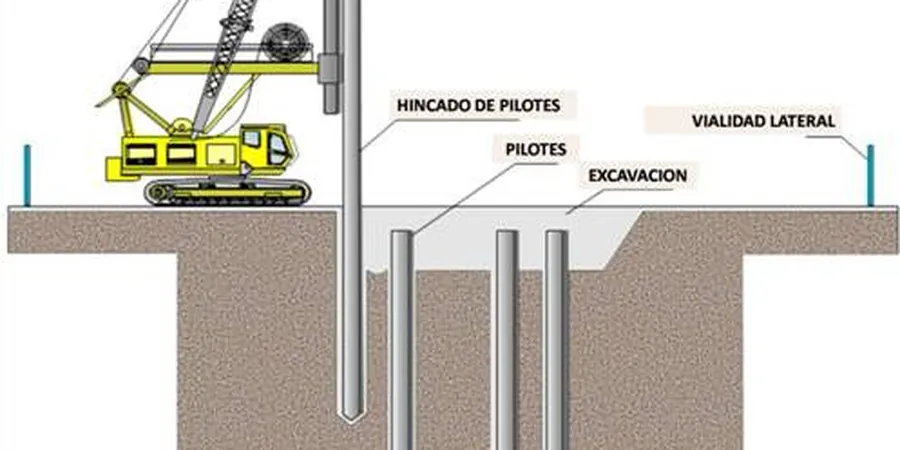
In Boise's basalt terrain, end bearing alone can mislead—skin friction often carries the foundation.
Process overview
Local context
A common mistake in Boise is assuming full end bearing on basalt without verifying rock quality. Weathering profiles vary widely from the Bench to the Foothills. If a pile tip sits on decomposed basalt, end bearing drops to less than 20 percent of intact rock values. This can lead to differential settlement of 2 inches or more between piles. Another risk is ignoring negative skin friction from settling fill in areas like the former landfill near the river. A proper pile skin friction vs. end bearing analysis captures these variables. Without it, foundations fail silently—cracks in walls, tilted floors, and costly repairs.
Reference standards
ASTM D1586-18 (Standard Penetration Test), IBC 2021 Chapter 18 (Soils and Foundations), ASCE 7-22 (Minimum Design Loads and Risk Category), ASTM D3966-16 (Field Load Testing of Deep Foundations)
Additional services
Static Load Test with Strain Gauges
Bi-directional Osterberg cell or top-down kentledge setup. Strain gauges at 5 ft intervals measure load distribution. Results separate skin friction and end bearing. Suitable for production piles or test shafts. Includes settlement curves and Davisson failure criteria analysis.
CAPWAP / PDA Dynamic Testing
Pile Driving Analyzer (PDA) with CAPWAP signal matching. For driven piles or drilled shafts. Provides shaft resistance, toe resistance, and soil damping parameters. Faster than static tests. Correlated with static load tests for verification. Meets ASTM D4945.
Typical parameters
Quick answers
How much does a pile skin friction vs. end bearing analysis cost in Boise?
Cost ranges from US$910 to US$3,190 depending on pile size, number of test piles, and instrumentation. A single Osterberg cell test on a 24-inch shaft runs about US$2,100. Dynamic testing with PDA starts at US$910. Volume discounts apply for multiple test piles on the same site.
When is skin friction more important than end bearing in Boise soils?
Skin friction dominates in the alluvial sands and silts that blanket most of the valley. These layers are 30 to 80 feet thick in areas like the Bench and West Boise. End bearing becomes critical only when piles reach basalt or dense gravel. A ratio analysis from load tests determines the actual contribution.
What is the difference between skin friction and end bearing in pile design?
Skin friction is the load carried by the shaft's side surface through soil-pile adhesion and friction. End bearing is the load transferred through the pile tip to a firm stratum. The sum gives ultimate capacity. The analysis separates these values because they mobilize at different settlements and have different safety factors per IBC 2021.
Can I use dynamic testing instead of a static load test for this analysis?
Yes, CAPWAP analysis from PDA data provides reliable separation of skin friction and end bearing. It costs less and takes less time. However, static load tests remain the reference standard for high-risk projects or when local building officials require proof of capacity. We recommend both for critical structures.