Boise has two very different soil stories. In the North End, near the foothills, you get sandy gravels with low plasticity, easy to compact but prone to shifting if you don't hit the right moisture. Down in the Bench area, the soils shift to silty clays with higher fines, which behave completely different under the roller. That is why we run the Proctor test before any earthwork here. It tells us exactly how much water and energy the soil needs to reach its best density. We run both Standard Proctor for general fills and Modified Proctor for heavy traffic zones. Before we even start, we pair the Proctor with a grain size analysis to know the material's base behavior. That one extra test saves a lot of guesswork later.
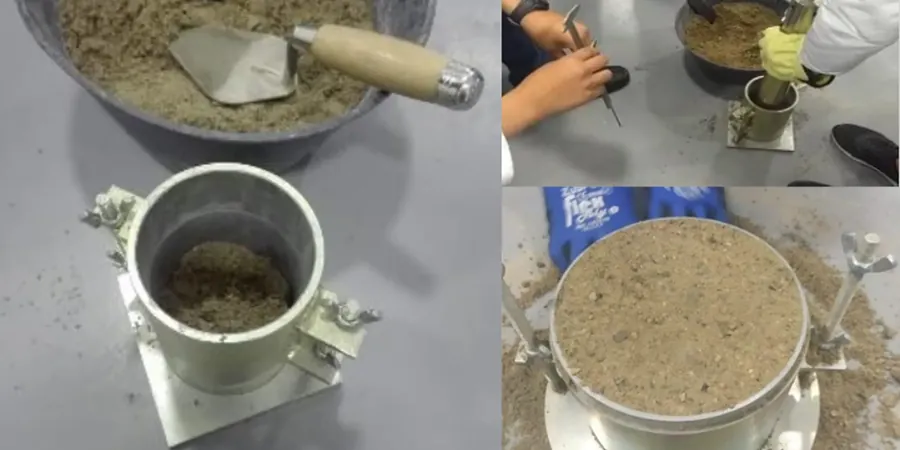
The Proctor test tells us exactly how much water and energy a Boise soil needs to hit its best density.
Process overview
Local context
Boise gets hot and dry in the summer, then cold and wet in the winter. That seasonal swing is the biggest risk for compaction. If you compact at the wrong moisture in July, the soil dries out before you place the next lift. You end up with a weak, friable layer that settles later. The Proctor test gives you a target moisture range, but you also have to manage water on site. In the foothills, the sandy gravels drain fast, so you need to add water and compact quickly. On the Bench, the silty clays hold water longer, so you might need to aerate before rolling. We always recommend a field density test after compaction to confirm the Proctor target was met.
Reference standards
ASTM D698-12 (Standard Proctor), ASTM D1557-12 (Modified Proctor), AASHTO T-99 / T-180, IBC 2021 Section 1804
Additional services
Standard Proctor Test (ASTM D698)
Standard compaction energy for general fills, backfills, and low-traffic areas. We run five moisture points and deliver the full moisture-density curve.
Modified Proctor Test (ASTM D1557)
Higher compaction energy for road bases, airport subgrades, and heavy-load zones. Recommended for Boise's commercial and industrial projects.
Field Density Verification
Sand cone or nuclear gauge testing after compaction to compare field density against the Proctor maximum. We confirm the percent compaction on site.
Moisture-Density Curve Analysis
Full curve plotting with zero air voids line. We identify the optimum moisture and maximum dry density for your specific Boise borrow source.
Typical parameters
Quick answers
What is the difference between Standard and Modified Proctor?
The difference is the compaction energy applied to the soil. Standard Proctor uses a 5.5 lb hammer dropped 12 inches over three layers. Modified Proctor uses a 10 lb hammer dropped 18 inches over five layers. Modified simulates heavier rollers and is used for high-load areas like roads and airports. For residential fills in Boise, Standard is usually sufficient. For commercial subgrades, we often recommend Modified.
How much does a Proctor test cost in Boise?
A Standard Proctor test typically ranges from US$90 to US$140. Modified Proctor runs slightly higher, between US$150 and US$240, due to the extra energy and time required. The final price depends on the number of samples and whether you need the full moisture-density curve or just the optimum point. We can give a exact quote once we know the soil type and project volume.
When should I run a Proctor test on my Boise project?
Run the Proctor test before any earthwork starts. You need the results to set the compaction target for the contractor. For Boise projects, we recommend testing each distinct soil type on site. If you have sand in one area and clay in another, each needs its own curve. The test takes 24 to 48 hours, so plan ahead. We also recommend a field density test after compaction to verify you hit the target.