Boise sits on a deep alluvial plain where loose sands and silts dominate the subsurface profile. Many projects we see here underestimate how much post-construction settlement can occur in these deposits. That is why we design vibrocompaction programs that densify loose granular soils before foundations go in. The technique uses a vibrating probe inserted to depth, creating lateral densification as the probe is withdrawn. For Boise's conditions, we typically target relative densities above 70% to meet IBC settlement limits, and we always cross-check results with CPT soundings before sign-off. Complementing the design with a densidad-cono-arena field test confirms the achieved compaction on-site.
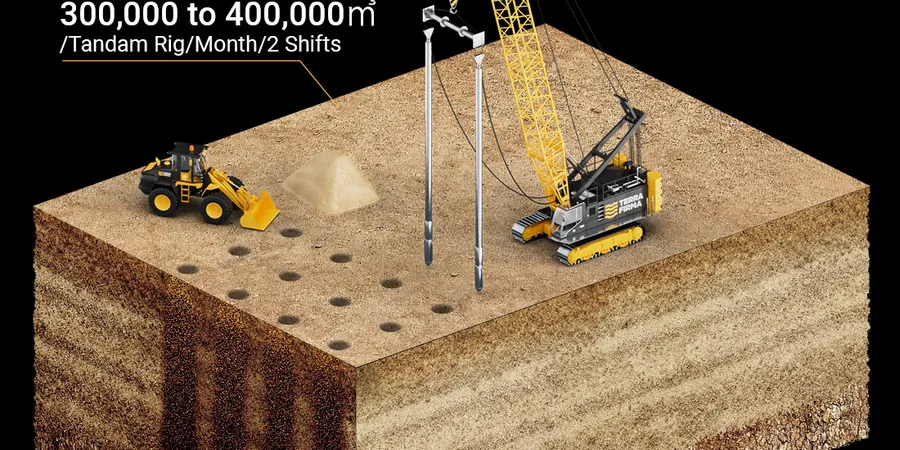
Vibrocompaction in Boise's alluvial sands can cut post-construction settlement by over 60% when probe spacing and energy are calibrated to site-specific SPT data.
Process overview
- Pre- and post-treatment CPT profiles
- Relative density contours for each depth interval
- Estimated settlement reduction factors (typically 50–70% reduction)
Local context
A warehouse project in west Boise used vibrocompaction but skipped post-treatment verification. The result was uneven densification and differential settlement exceeding 50 mm within the first year. That is a clear risk: without CPT or SPT confirmation, loose pockets remain undetected. We always require a minimum of one verification sounding per 500 m² after compaction. For sites with high groundwater — common near the Boise River — we model the liquefaction potential using the NCEER method before and after treatment. If the fines content is borderline, a suelos-colapsibles assessment helps decide whether vibrocompaction alone is sufficient or if additional stabilization is needed.
Reference standards
ASTM D1586-18 (SPT), ASTM D5778-20 (CPT), IBC 2021 Section 1806, Seed & Idriss (1971) liquefaction framework
Additional services
Full Design with Verification
Includes site investigation review, probe pattern design, post-treatment CPT verification, and a settlement analysis report. Suitable for commercial and industrial projects with strict settlement tolerances.
Design-Only Package
Covers grid layout, energy requirements, and depth specifications based on existing geotechnical data. The client manages field execution; we provide the technical parameters and acceptance criteria.
Typical parameters
Quick answers
How does vibrocompaction differ from deep dynamic compaction in Boise soils?
Vibrocompaction uses a vibrating probe to densify loose granular soils at depth without impact loading. Deep dynamic compaction relies on repeated heavy drops from a crane. For Boise's saturated sands near the river, vibrocompaction is usually preferred because it causes less vibration disturbance to adjacent structures and achieves more uniform densification at depth.
What is the typical cost range for a vibrocompaction design in Boise?
Our design fee for a typical medium-size project in Boise falls between US$1.390 and US$5.750 depending on the number of treatment zones, required verification soundings, and reporting depth. Field execution costs are additional and vary with contractor rates and probe hours.
Can vibrocompaction be used on Boise's silty alluvial deposits?
It works best when fines content (passing #200 sieve) is below 15%. For Boise's silty layers above that threshold, we recommend combining vibrocompaction with wick drains or stone columns to improve drainage and densification efficiency. A grain-size analysis is essential before committing to this method.
How long does a vibrocompaction design study take?
A typical design with pre- and post-treatment CPT verification takes 3 to 5 business days from receipt of site data. If we need to perform the field investigation ourselves, add 2 to 4 days for drilling and testing, depending on site access and number of test points.