Boise sits on the Boise River floodplain, where the water table can rise within 3 meters during spring runoff. That combination of shallow groundwater and loose silty sands makes deep soil mixing the go-to method for ground improvement before foundations go in. We have designed DSM column grids for commercial pads along Chinden Boulevard and for embankments near the river corridor. The local geology demands a mix design that accounts for the high fines content and seasonal moisture swings. Before any DSM design begins, we run a placa de carga on the native soil to establish baseline stiffness values. That data feeds directly into the column spacing and binder dosage calculations. The result is a treated ground mass that meets both strength and settlement targets without overdesigning the cement content.
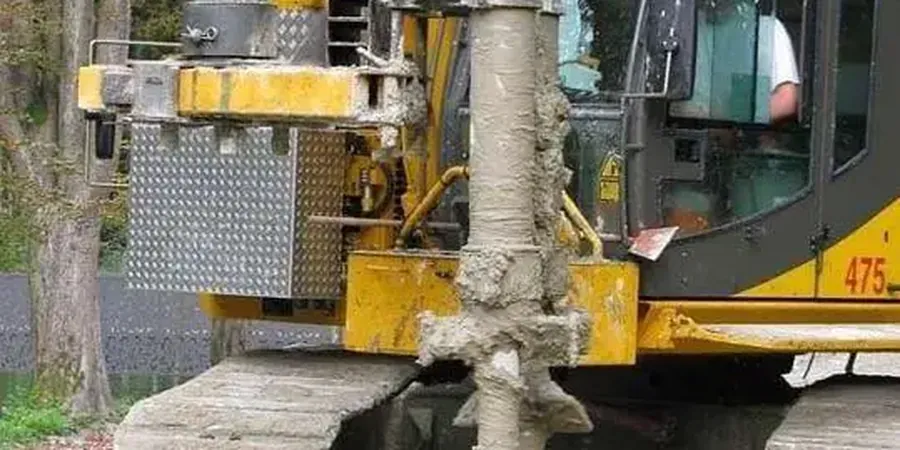
Treated DSM columns in Boise's alluvial soils reach unconfined compressive strengths of 1.0 to 3.5 MPa, cutting total settlements by 60–80%.
Process overview
Local context
In Boise, many times we see DSM designs that ignore the lateral variability of the fluvial deposits. A site may have a 2-meter lens of clean sand over a soft clay layer. If the column spacing is uniform across the whole footprint, the soft clay gets under-treated. That leads to differential settlements of 5–8 cm under heavy loads. The fix is simple: use a phased approach with a test column panel, extract core samples, and adjust the mix design zone by zone. We always include a trial area before full-scale production to verify that the wet-grab strengths match the design assumptions.
Reference standards
ASTM D1586-18 (Standard Test Method for Standard Penetration Test), IBC 2021 (International Building Code, Chapter 18 – Soils and Foundations), FHWA-HRT-17-003 (Deep Mixing for Embankment and Foundation Support), ASCE 7-22 (Minimum Design Loads and Associated Criteria for Buildings)
Additional services
DSM Mix Design and Trial Panels
Laboratory formulation of binder blends followed by field trial panels. We test wet-grab strength, core recovery, and permeability at 7, 14, and 28 days. The trial panel validates the design before production starts.
Post-Treatment Verification Testing
Core drilling through treated columns, unconfined compression tests, and point-load index tests. We compare results against the target strength and adjust the production mix if needed.
Typical parameters
Quick answers
What is the typical cost range for deep soil mixing design in Boise?
The cost for the design and field verification program typically ranges between US$1,650 and US$6,300, depending on the number of trial columns and the extent of laboratory testing required. A full production design with multiple zones may fall on the higher end.
How deep can DSM columns go in Boise's alluvial soils?
In the Treasure Valley, DSM columns are typically installed to depths between 6 and 18 meters. The practical limit is set by the torque capacity of the equipment and the presence of gravel layers or cobbles, which can damage the mixing tool.
What soil conditions in Boise are best suited for DSM?
DSM works best in loose sands, silty sands, and soft clays with natural water contents above 20%. It is less effective in clean gravels or soils with large cobbles, where the mixing energy cannot achieve uniform binder distribution.
How long does a DSM design study take from start to finish?
A typical DSM design study in Boise takes 3 to 5 weeks. That includes site investigation, laboratory mix design, a 2-week curing period for trial columns, and the final report with column layout and specifications.