Boise sits at an elevation of 2,730 feet on the edge of the Snake River Plain, where the subsurface transitions from alluvial sands and gravels to silty clay over basalt. This variability makes road subgrade design in Boise a site-specific exercise. We evaluate the subgrade's California Bearing Ratio (CBR) and resilient modulus using both laboratory and field methods. For projects requiring deeper characterization, we combine the subgrade assessment with an ensayo SPT to correlate blow counts with bearing capacity, and use clasificación de suelos via the Unified Soil Classification System to anticipate frost heave potential. These steps ensure the subgrade meets AASHTO and IBC criteria before pavement design begins.
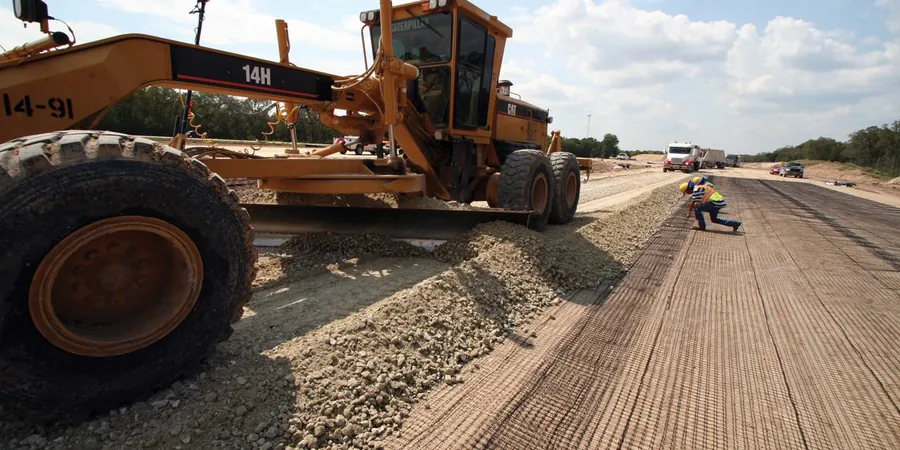
A CBR of 3 versus 15 can triple the required pavement thickness. Getting the subgrade design right saves money over the road's life.
Process overview
- In-situ density and moisture via sand cone or nuclear gauge
- CBR at field density and after soaking (4 days)
- Atterberg limits and grain-size distribution per ASTM D4318 and D6913
- Resilient modulus for flexible pavement design
Local context
The most frequent mistake we see in Boise is designing the pavement section based on assumed CBR values from nearby projects. Subgrade conditions in the North End differ completely from those in the Bench or Meridian. A silty clay subgrade with a soaked CBR of 4 will settle under traffic if treated as a CBR 10 material. This leads to premature cracking and rutting. We also flag the risk of frost heave in fine-grained subgrades with high PI. Skipping the soaked CBR test is another common error — dry CBR numbers overestimate strength. Proper road subgrade design in Boise requires testing the actual soil at the actual moisture conditions the pavement will face.
Reference standards
AASHTO T-193 (CBR), ASTM D4318 (Atterberg Limits), ASTM D698 (Standard Proctor), ASTM D2487 (USCS Classification)
Additional services
Subgrade Soil Classification
Full USCS and AASHTO classification including grain-size analysis, Atterberg limits, and natural moisture content.
CBR and Resilient Modulus Testing
Laboratory CBR at field density and soaked conditions, plus resilient modulus (Mr) for mechanistic-empirical pavement design.
Compaction Control and Density Testing
Standard and modified Proctor curves, field density tests via sand cone or nuclear gauge, and percent compaction verification.
Stabilization Recommendations
Evaluation of cement, lime, or fly ash stabilization based on soil chemistry, PI, and target strength gain.
Typical parameters
Quick answers
What is the standard CBR value used for road subgrade design in Boise?
There is no single standard. Typical values range from 3 to 15 for the native soils we encounter. We always recommend site-specific testing because a difference of just a few points changes the required pavement thickness significantly.
How does frost depth affect subgrade design in Boise?
Boise's frost depth is approximately 24 to 36 inches. The subgrade design must consider whether the soil is frost-susceptible (fine-grained with PI > 10). If it is, we either replace the upper 24 inches with non-frost-susceptible material or design for a thicker granular base to minimize heave.
What is the typical cost range for a road subgrade design study?
For a typical two-lane road project in Boise, expect between US$1,040 and US$3,420 depending on the number of test pits, lab tests required, and the complexity of the soil profile. This includes classification, CBR, and compaction testing.
What lab tests are essential for subgrade design?
At minimum, we perform grain-size analysis, Atterberg limits, Standard Proctor compaction, and soaked CBR. For flexible pavements, we also recommend resilient modulus testing. All tests follow ASTM or AASHTO standards to ensure the design values are reliable.