ASCE 7 and the 2021 IBC require a measured shear wave velocity (VS30) for Seismic Site Class C, D, E, or F determinations, and in Boise that mandate carries real weight. The Treasure Valley sits atop deep alluvial basins—locally up to 2,000 feet of Quaternary sediments—where the contrast between stiff basalt bedrock and loose river deposits can shift site class by two letters. A MASW survey gives us the continuous velocity profile without boreholes, deploying a 24-channel landstreamer with 4.5 Hz geophones along 200-meter spreads. We use multichannel analysis of surface waves to invert the Rayleigh-wave dispersion curve, producing a 1D VS profile down to 30 meters or deeper. That profile feeds directly into site class per Table 20.3-1 of ASCE 7-22, and we cross-check with ambient noise HVSR (microtremor) data when basin-edge effects are suspected. For shallow foundations on the Bench, where Tertiary basalt sits within 5 meters of grade, the VS30 often exceeds 760 m/s (Site Class B). But along the Boise River and in the North End, where silty sands and gravels extend past 15 meters, we routinely measure VS30 between 250 and 400 m/s, putting you in Site Class D or even E. Getting that number right before design avoids costly overdesign or, worse, an under-designed lateral system.
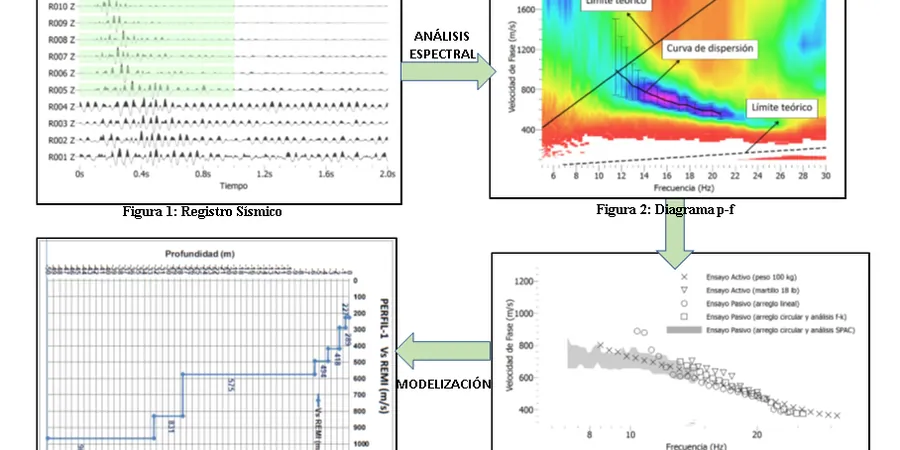
A single MASW line along Boise's river corridor can shift a design from Site Class C to D, altering base shear by 30 percent.
Process overview
Local context
We worked a 12-story residential tower near the Boise River Greenbelt, where the geotechnical report assumed Site Class D based on blow counts alone. After our MASW survey, the VS30 came in at 285 m/s—solidly Site Class E. That changed the seismic base shear from 0.18g to 0.28g under ASCE 7-16. The foundation system had to be redesigned from spread footings to a 36-inch mat with deep soil mixing. The owner nearly sued the original consultant. A $12,000 MASW line would have caught it during the feasibility phase. In Boise, where the water table sits 8 feet down in many lots, you cannot rely on SPT alone for site class. The shear wave velocity tells you the true stiffness of the soil skeleton, not the disturbed resistance. Ignoring that distinction can bury a project in change orders.
Reference standards
ASTM D4428 / D4428M-14 — Standard Test Methods for Crosshole Seismic Testing, ASCE 7-22 Section 20.3 — Site Classification for Seismic Design, NEHRP Recommended Provisions (FEMA P-1050) — VS30-based site class, IBC 2021 Chapter 16 — Seismic Design Categories
Additional services
MASW Survey & VS30 Report
Full 24-channel landstreamer survey with dispersion-curve inversion. Deliverables include VS profile to 30 m, site class per ASCE 7, and a written report with raw shot gathers and interpreted shear wave velocities. Typical turnaround is 5 business days.
HVSR / Microtremor Array
Ambient noise measurements using a three-component broadband seismometer to capture the fundamental site period (T0). We deploy 15-minute recordings at each station and process using the Nakamura method. Useful for basin-edge effects in the Boise Front Fault zone.
Integrated Seismic Hazard Assessment
Combines MASW, HVSR, and downhole PS logging (if available) to produce a site-specific response spectrum per ASCE 7-22. Includes deaggregation for magnitude-distance scenarios and deterministic check for near-fault pulses from the Boise Front Fault.
Typical parameters
Quick answers
What is VS30 and why does it matter in Boise?
VS30 is the average shear wave velocity in the upper 30 meters of soil. It is the primary parameter for assigning Seismic Site Class per ASCE 7. In Boise, the range spans from >760 m/s on the Bench (Site Class B) to <300 m/s along the river corridor (Site Class D/E), so getting VS30 right directly affects base shear calculations and foundation design.
How does MASW compare to downhole PS logging for VS30?
MASW is non-invasive, faster, and cheaper than downhole PS logging. It gives a continuous 1D profile from surface waves, while downhole requires a borehole and a source at depth. In Boise's alluvial soils, MASW uncertainty of ±15% is acceptable for site class per NEHRP. We recommend downhole only when very high precision is needed for a specific depth interval.
What is the typical cost range for a MASW survey in Boise?
For a standard 200-meter line with 24 channels, data processing, and a VS30 report, the cost typically falls between US$1,850 and US$3,490. Larger projects with multiple lines or deeper profiles (40+ m) will be at the higher end. The price includes mobilization within Ada County.
Can MASW detect the water table in Boise's alluvial soils?
Indirectly, yes. The shear wave velocity is sensitive to effective stress, so the water table often appears as a change in the VS gradient. In Boise's river corridor, we frequently see a VS inflection at 8-12 feet depth corresponding to the water table. However, for precise water table location, we recommend combining MASW with a resistivity survey or test pits.
How long does a MASW survey take on a typical Boise lot?
A single 200-meter line takes about 2-3 hours in the field, including setup, shooting, and quality control. Data processing and inversion add another 4-6 hours. Total turnaround from field to report is usually 5 business days. We can accelerate to 2 days for an additional rush fee.