Soils in the North End tend to be stiff clay till, while down by the Boise River you hit soft silts and organic layers. That difference matters when you need undrained shear strength numbers. Running an unconfined compression test (UCS) on undisturbed samples from both areas gives you a direct read on how the ground will behave under load. Before we even start, we always check sample quality — a good UCS result is only as reliable as the core you took. For projects where clay layers are thick, we often pair this with a consolidation test to predict long-term settlement, or with undisturbed sampling to ensure the specimen structure stays intact all the way to the lab.
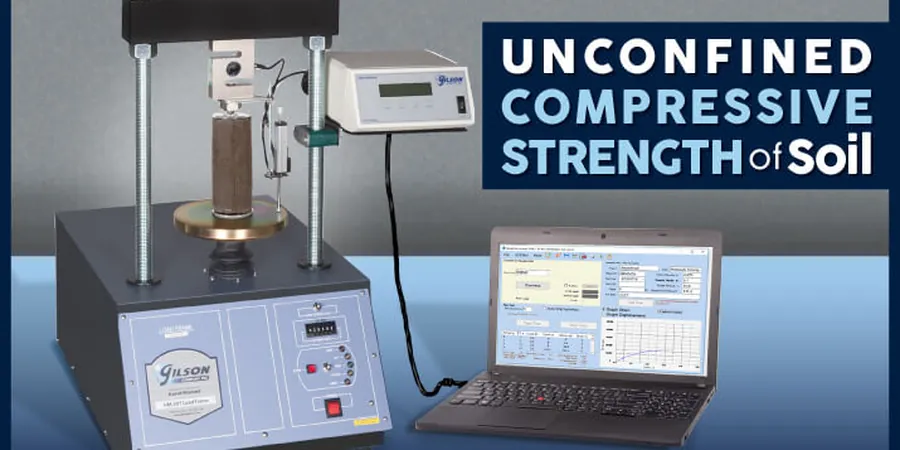
A reliable UCS result depends entirely on sample quality — a disturbed core produces meaningless numbers, no matter how good the lab equipment is.
Process overview
Local context
Boise sits at about 2,700 feet elevation in the Treasure Valley, and while we don't get large earthquakes often, the 2020 Stanley quake (M6.5) sent tremors through the valley. Saturated silty clays along the river corridor can lose strength rapidly under cyclic loading. An unconfined compression test (UCS) alone won't tell you the full liquefaction story, but it gives a baseline undrained strength that feeds into simplified evaluations. Without that baseline, you're guessing how much the ground can hold before it fails. That's a risk no foundation budget should carry.
Reference standards
ASTM D2166-16 (Standard Test Method for Unconfined Compressive Strength of Cohesive Soil), ASTM D1587-15 (Standard Practice for Thin-Walled Tube Sampling), ASTM D2488-17 (Standard Practice for Description and Identification of Soils)
Additional services
UCS on Intact Tube Samples
We test undisturbed thin-wall tube samples from your boreholes, trimming them to exact L/D ratios and running the compression test with full stress-strain recording.
UCS on Block Samples
For test pits or hand-carved blocks, we carefully trim the specimen in our lab to avoid disturbance and report qu with moisture content data.
Quick-Look UCS Screening
Need fast numbers for preliminary design? We offer a streamlined UCS with a single specimen and same-day verbal results, followed by a written report.
UCS with Moisture & Density Correlation
We combine each UCS test with natural moisture content and wet density to help you interpret strength variations across different clay layers.
Typical parameters
Quick answers
What is the difference between UCS and triaxial compression test?
UCS runs on an unconfined specimen with no lateral pressure — it measures undrained strength for cohesive soils only. A triaxial test applies confining pressure to simulate in-situ stress conditions and works for both cohesive and granular soils. For Boise's stiff clays, UCS is faster and cheaper; for deep foundations or embankments, triaxial gives more realistic parameters.
How much does an unconfined compression test (UCS) cost in Boise?
For a standard UCS on a single tube sample with full report, expect to pay between US$320 and US$520. Volume discounts apply when you submit multiple samples from the same project. Price may vary slightly if you need rush processing or additional moisture/density tests.
When should I request UCS instead of a pocket penetrometer estimate?
Use UCS when you need a defensible number for design reports, permit submittals, or settlement calculations. A pocket penetrometer gives a rough field estimate — good for screening — but cannot replace a lab test when the engineer needs a precise undrained shear strength value under controlled conditions.