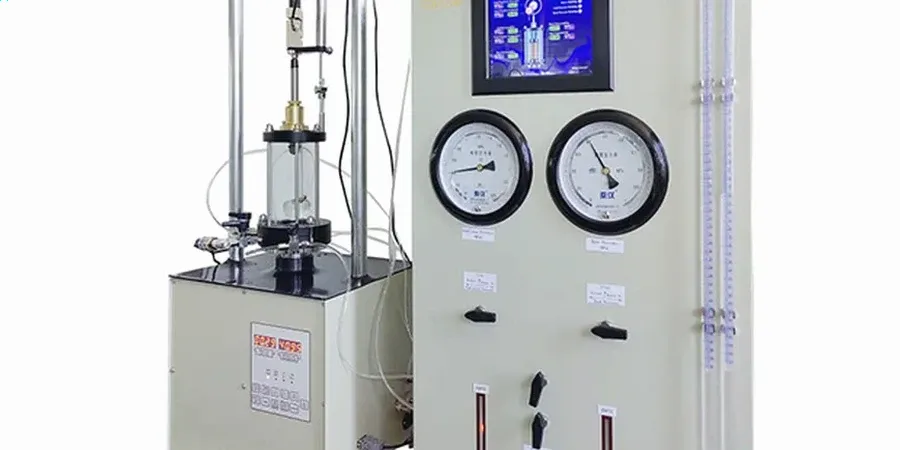
The triaxial test cell sits in our Boise laboratory, a transparent cylinder where a soil specimen extracted from the Treasure Valley gets confined by water pressure while a loading piston applies axial stress. Unlike simpler shear tests, this setup lets us control drainage conditions precisely—consolidated drained for long-term analysis of stiff Boise foothills clays, or consolidated undrained with pore pressure measurement for rapid loading scenarios on alluvial deposits near the Boise River. The equipment records deviator stress and excess pore pressure at each stage, producing the Mohr-Coulomb envelopes that feed directly into bearing capacity equations for shallow foundations. For deeper investigations, we often pair triaxial data with CPT testing to correlate continuous tip resistance profiles with lab-measured strength at discrete depths, building a more complete picture of the subsurface before designing deep foundations.
A triaxial test measures what a pocket penetrometer cannot: the effective friction angle and true cohesion that govern long-term stability in Boise’s expansive clay formations.
Our approach and scope
Local ground factors
The Treasure Valley’s climate swings from arid summers to saturated winters, creating soil moisture profiles that fluctuate dramatically in the upper 10 feet—precisely where most Boise footings bear. A soil sampled in August may test strong in an unconsolidated undrained triaxial test, but that same material remolded and saturated under spring runoff conditions can lose 40% of its undrained shear strength. The Glenns Ferry and Idaho Group formations underlying much of Boise contain overconsolidated silts and clays with pronounced strain-softening behavior; peak strengths measured in the lab must be reduced to residual values for design if progressive failure is a concern, as it often is in cuts exceeding 15 feet along the Boise Front. Ignoring effective stress analysis in these materials has caused retaining wall distress and slope movements documented in several Treasure Valley residential developments during the wet winters of 2017 and 2023.
Relevant standards
The triaxial testing procedures for cohesive soils include the ASTM D4767-11 consolidated undrained method, the ASTM D2850-15 unconsolidated-undrained method, and the ASTM D7181-20 consolidated drained method for evaluating soil shear strength.
Other technical services
Consolidated Undrained (CU) Triaxial with Pore Pressure
The standard for Boise foundation design. Specimens are saturated, consolidated to in-situ stress, then sheared undrained while we record excess pore pressure. Effective stress parameters c’ and φ’ are calculated for long-term drained analysis, while total stress parameters provide undrained strength for short-term bearing capacity checks.
Consolidated Drained (CD) Triaxial
Required when analyzing long-term stability of slopes and cuts in the Boise foothills. The specimen is sheared slowly enough to prevent pore pressure buildup, yielding drained friction angles directly. We recommend this for overconsolidated Glenns Ferry clay where drained strength governs the critical condition.
Unconsolidated Undrained (UU) Triaxial
Used for rapid assessment of cohesive soil strength at natural moisture content, often during preliminary site investigations. The test provides undrained shear strength (Su) without pore pressure measurement. We run UU tests when turnaround time is tight and the soil will be loaded quickly, such as during temporary excavation support design in Boise’s urban infill projects.
Typical parameters
Common questions
When does a Boise project need a triaxial test instead of a direct shear test?
Triaxial testing becomes necessary when pore water pressure during loading matters for design—which is most Boise projects involving saturated or partially saturated fine-grained soils. The triaxial cell measures excess pore pressure directly, giving engineers effective stress parameters (c’, φ’) for drained analysis. Direct shear cannot measure pore pressure and forces drained conditions regardless of field drainage rates. For Treasure Valley clays with low permeability, assuming drained behavior in a direct shear test can overestimate strength by 15–30% compared to triaxial CU results.
What confining pressures should we specify for a Boise footing investigation?
Confining pressures should bracket the anticipated in-situ effective stress at the foundation bearing depth. For typical Boise residential footings at 3–5 feet depth, we recommend three confining pressures such as 5, 10, and 20 psi. For deeper commercial foundations or when evaluating deeper strata, the range should extend to 40–60 psi. Specifying pressures too low will not capture the stress-dependent nature of friction angle; too high may crush the soil structure and yield unrepresentative parameters.
How much does triaxial testing cost for a Boise project?
How long does a triaxial test program take from sample delivery to report?
A standard CU triaxial program on three Boise specimens takes approximately 10–14 business days from sample receipt to final report. The timeline breaks down into specimen preparation and saturation (2–3 days), consolidation (1–2 days per specimen), shearing (1 day per specimen), and data reduction with report preparation (2–3 days). CD tests extend this by a week or more because shearing must proceed slowly enough to dissipate pore pressures. We can expedite UU testing to 3–5 days when project schedules demand it.
What soil types in the Boise area benefit most from triaxial testing?
The Glenns Ferry Formation clays and silts that underlie much of Boise’s developed area respond particularly well to triaxial analysis. These overconsolidated soils exhibit pronounced strain-softening and their strength depends heavily on whether they are tested drained or undrained. Alluvial silts along the Boise River corridor also require triaxial testing because their partially saturated condition in summer gives misleadingly high strengths in simpler tests. Granular Boise River sands can be tested triaxially when the project requires deformation modulus (E) in addition to friction angle, such as for settlement-sensitive structures on the floodplain.