Boise grew fast after the war, pushing new subdivisions into the bench areas and river terraces. Those older fills were rarely tested, and today we see the consequences in differential settlement and cracked slabs. That is why we run field density tests with the sand cone method on every compacted lift. This test tells us exactly how well the soil was densified against the Proctor optimum. For deep fills or sensitive projects, we often combine it with a plate load test to confirm bearing capacity under real loads. The method is simple but unforgiving — if the technician misreads the calibrated sand, the whole number is off.
On a typical Boise subdivision fill, we see compaction values range from 92% to 97% — anything below 95% usually gets reworked.
Process overview
Local context
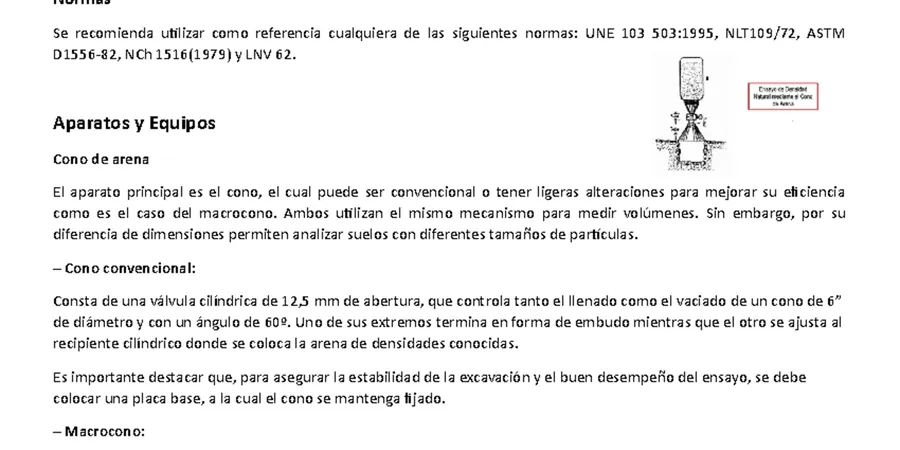
The sand cone equipment itself is straightforward — a two-piece base plate, a 4-inch jar, and a metal cone valve. But in Boise's dry climate, the sand can pick up static charge and bridge inside the cone, causing an incomplete fill. We check for that by re-weighing the jar after every test. If the sand left in the jar does not match the calibration curve, we reject the result and re-run. A bad density test can cost weeks in rework or, worse, a failed slab that cracks under load. That is why our technicians follow a strict step-by-step checklist on every Boise job site.
Reference standards
ASTM D1556-16 (Standard Test Method for Density and Unit Weight of Soil in Place by the Sand-Cone Method), AASHTO T-191 (Density of Soil In-Place by the Sand-Cone Method), ASTM D698 / D1557 (Standard Proctor and Modified Proctor compaction)
Additional services
Sand Cone Density Testing
On-site field density tests using the sand cone method for lifts, trench backfill, and subgrade verification. Results reported the same day.
Moisture Content Determination
Oven-dry moisture content on the extracted soil sample, correlated to the compaction curve to ensure the lift is within optimum moisture range.
Compaction Curve Calibration
Modified Proctor and standard Proctor tests performed in our Boise lab to establish the target maximum dry density for each material type.
Typical parameters
Quick answers
How much does a field density test (sand cone) cost in Boise?
A single sand cone test typically runs between $100 and $130 per point, including the moisture content. Volume discounts apply for multi-lift projects or repeat visits.
What compaction percentage is required for structural fills in Boise?
Most Boise building departments require 95% of the modified Proctor maximum dry density for structural fills, per IBC 2021. Non-structural areas may accept 92%.
Can the sand cone test be used on gravelly soils?
The method works best for soils with particles smaller than 2 inches. If your fill contains larger gravel, we recommend using the nuclear gauge or the rubber balloon method instead.
How long does a sand cone test take in the field?
Each test takes about 20 to 30 minutes per point, including digging the hole, filling with sand, and collecting the moisture sample. Results are available within 24 hours.