Preloading with surcharge design in Boise must account for the deep alluvial deposits and high groundwater table typical of the Treasure Valley. Under IBC Chapter 18 and ASCE 7, the design of a surcharge program relies on consolidation parameters from lab oedometer tests. For projects on the Boise River floodplain, where soft lacustrine clays can exceed 15 meters, we typically combine a preload height of 3 to 6 meters with a surcharge ratio of 1.2 to 1.5 to accelerate primary consolidation. The settlement analysis uses the coefficient of consolidation (Cv) and compression index (Cc) obtained from undisturbed samples. Integrating a consolidation test program with field instrumentation like settlement plates and piezometers ensures the design matches real-world behavior under the imposed load.
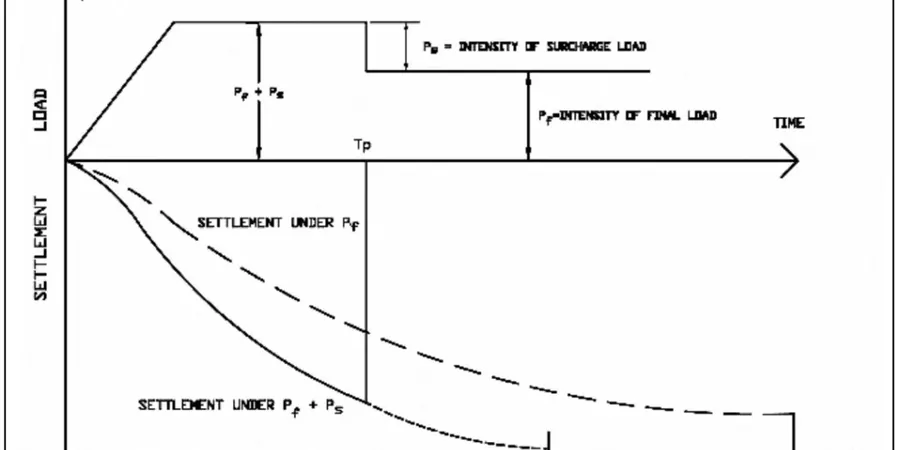
Matching the surcharge ratio to the local void ratio and groundwater depth prevents differential settlement that cracks structures and pavements.
Process overview
- Pre-consolidation pressure (Pc) from oedometer curves
- Hydraulic conductivity via falling-head tests
- Undrained shear strength from veleta de campo or triaxial UU
- Creep behavior (secondary compression) for long-term performance
Local context
The Treasure Valley sits on a deep sedimentary basin filled with interbedded silts, clays, and sands from Pleistocene Lake Idaho. Below about 8 meters, these deposits are normally consolidated, meaning any additional load from a surcharge triggers rapid settlement. If the preloading design ignores the lateral drainage boundaries or the secondary compression of the organic silt layers near the Boise River, total settlements can exceed predicted values by 30%. We have seen structures settle differentially up to 15 cm when surcharge was removed too early based on pore pressure dissipation alone, without verifying the degree of consolidation via field plate load tests.
Visual overview
Reference standards
ASTM D2435 – Standard Test Methods for One-Dimensional Consolidation Properties of Soils, IBC 2021 Chapter 18 – Soils and Foundations (Section 1803), ASCE 7-22 – Minimum Design Loads and Associated Criteria for Buildings, FHWA NHI-16-072 – Ground Modification Methods Reference Manual
Additional services
Complete Surcharge Design & Monitoring
Full design package including consolidation testing, stability analysis, staged loading schedule, and field instrumentation with settlement plates and piezometers. Includes monthly monitoring reports for up to 12 months.
Preload Optimization Study
For sites with existing geotechnical data, we perform a focused analysis to optimize surcharge height and duration, potentially reducing fill volume by 20-30%. Includes parametric study and construction recommendations.
Typical parameters
Quick answers
How long does preloading with surcharge typically take in Boise soils?
For the silty clays of the Treasure Valley, primary consolidation usually completes within 3 to 8 months under a 4-meter surcharge. With vertical drains, this can drop to 2 to 4 months. The actual duration depends on the coefficient of consolidation (Cv) and drainage path length.
What is the typical cost range for a preloading with surcharge design in Boise?
For a standard commercial site in the Boise area, the engineering design and monitoring package typically ranges between US$750 and US$2,650. Larger projects with extended monitoring or complex soil profiles may exceed this range.
Can preloading be used on sites with high groundwater in the Boise River floodplain?
Yes, but careful dewatering or wick drains are often needed. The high water table reduces effective stress, so the surcharge height must be calculated using submerged unit weights. We typically install vibrating-wire piezometers to track pore pressure dissipation in real time.
How do I know when the surcharge can be removed?
Removal criteria are based on two factors: measured settlement reaching 90% or more of the predicted primary consolidation settlement, and pore pressure dissipation below 10% of the applied load. We verify both with field instrumentation before issuing the removal authorization.
What happens if the surcharge is removed too early?
Removing the surcharge before sufficient consolidation can lead to post-construction settlements of 5 to 15 cm over the following years. This often causes cracking in floor slabs, misalignment of utilities, and uneven pavement. The residual settlement is typically differential, making repairs expensive.