Boise sits in a high-desert valley where summer temperatures push past 100°F and winter freeze-thaw cycles can crack asphalt within a single season. Those conditions shorten pavement life fast. That is why an existing pavement evaluation in Boise needs to account for thermal cracking, base-layer saturation from snowmelt, and subgrade weakening on the silty clay soils typical of the Treasure Valley. A thorough assessment combines visual distress surveys with structural testing to determine if the pavement can handle overlay or needs full reconstruction. Often the evaluation includes a subrasante vial analysis to check whether the supporting layers have lost stiffness over time. This baseline data is the only way to avoid spending money on a fix that fails within two winters.
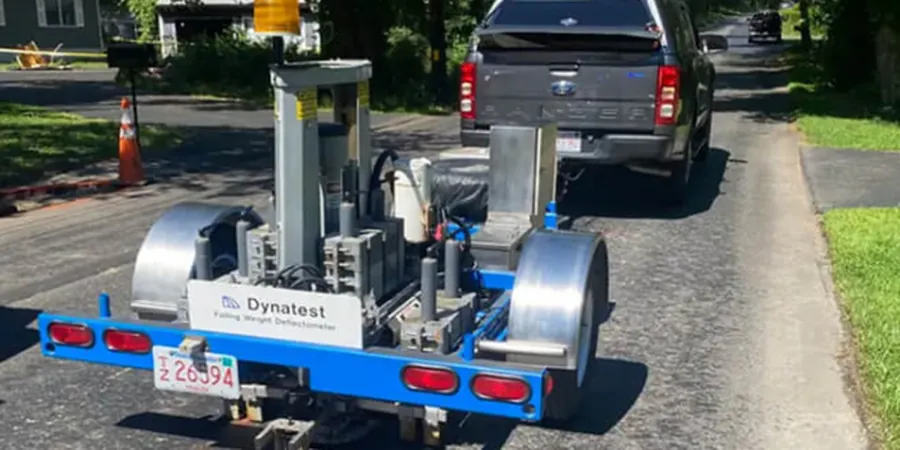
A pavement evaluation that ignores freeze-thaw damage to base layers will underestimate required overlay thickness by 30% or more in Boise’s climate.
Process overview
Local context
IBC 2021 and AASHTO M 147-17 both require that pavement rehabilitation designs be based on measured layer properties, not assumed values. In Boise, the biggest risk is underestimating the effect of frost heave on granular base layers — many roads built before 1990 used unbound aggregate that now has high fines content. An existing pavement evaluation in Boise must include moisture-sensitive tests because the spring thaw often turns a stable road into a muddy failure. Skipping the evaluation means designing an overlay that cracks longitudinally within two loading seasons. The cost of a full-depth repair later is typically three to five times the evaluation fee.
Reference standards
ASTM D4694-09 (FWD deflection), ASTM D5361-16 (asphalt coring), AASHTO T 307-99 (resilient modulus), ASTM D217 (binder penetration)
Additional services
Non-Destructive Deflection Testing (FWD / LWD)
Falling weight deflectometer testing at 100-ft intervals on urban roads and 200-ft on highways. Data is back-calculated using AASHTO 1993 or mechanistic-empirical models to determine layer moduli. Reports include deflection basin parameters and recommended overlay thickness.
Pavement Coring & Laboratory Characterization
Core extraction with a gas-powered rig, thickness measurement, binder recovery, and penetration grading. Subgrade samples are tested for moisture content, Atterberg limits, and CBR. Results are integrated with FWD data for a unified rehabilitation recommendation.
Typical parameters
Quick answers
How long does an existing pavement evaluation take in Boise?
A typical evaluation for a 1-mile stretch takes two days of field work (coring and FWD) plus five working days for lab testing and reporting. Weather delays are rare because the team works around rain and frost.
What is the difference between FWD and coring in an evaluation?
FWD measures structural capacity of the entire pavement system without destroying it. Coring gives physical thickness and binder condition. Both are needed — FWD shows how the layers perform together, while coring tells you why they perform that way.
How much does an existing pavement evaluation in Boise cost?
Rates typically range between US$1.080 and US$4.220 depending on project length, number of cores, and whether FWD is included. The laboratory binder testing adds about US$180 per sample.
Do you evaluate concrete pavements or only asphalt?
We evaluate both. For rigid pavements we use FWD with joint load transfer analysis and take concrete cores for compressive strength and thickness. The process is similar but the distress criteria follow PCA guidelines instead of AASHTO for asphalt.