Under IBC 2021 and ASTM D6276-19, lime and cement stabilization is a proven method for treating problematic soils in Boise, where the region's alluvial deposits and expansive clays pose challenges for pavement and foundation support. The Treasure Valley's high-plasticity clays shrink and swell with moisture changes, making chemical stabilization a reliable solution. By injecting quicklime or Portland cement into the soil matrix, the team achieves a durable subgrade with reduced plasticity index and increased CBR values. For projects requiring deeper treatment, the service can be combined with jet grouting to remediate soft zones below the active layer, ensuring uniform support for structural loads.
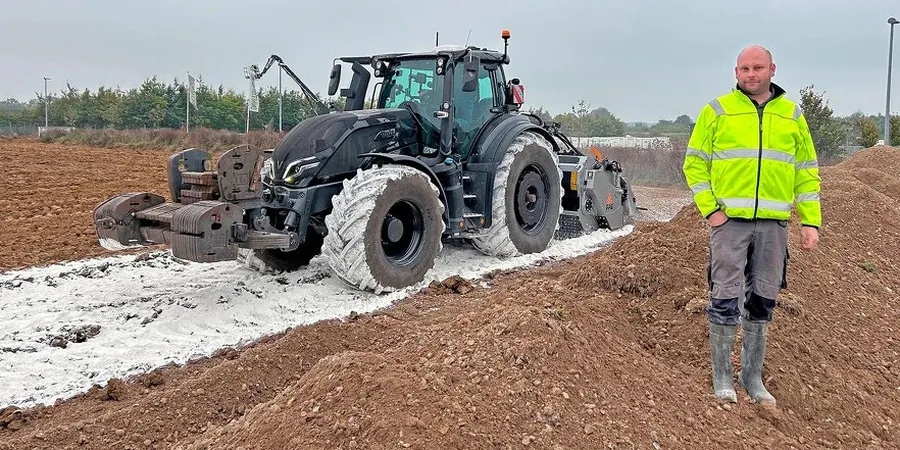
Lime stabilization reduces plasticity index by 50–70% in Boise's expansive clays, transforming subgrade from problematic to structural support material.
Process overview
Local context
Boise's rapid suburban growth since the 1990s pushed development onto lacustrine clays and collapsible loess deposits. Early subdivisions in the Foothills experienced pavement cracking and foundation movement because developers skipped chemical stabilization. The city's current stormwater code requires runoff management, but untreated clays still heave when wetted. Failing to stabilize these soils leads to differential settlement of slabs and road bases. The team's protocol includes a permeability test in laboratory on treated specimens to confirm hydraulic conductivity below 1×10⁻⁶ cm/s, preventing water infiltration into untreated layers below.
Reference standards
ASTM D6276-19 (Standard Test Method for Using pH to Estimate the Soil-Lime Proportion Requirement), IBC 2021, Section 1804.2 (Fill and Backfill Requirements), ASTM D4609-08 (Guide for Evaluating Effectiveness of Admixtures for Soil Stabilization)
Additional services
Laboratory Mix Design
Determination of optimum stabilizer type and dosage via pH testing (ASTM D6276), Atterberg limits, and unconfined compressive strength on cured specimens. Includes plasticity index reduction verification and CBR testing for pavement design.
Field Application and Compaction
Rotary mixing to depths of 300–600 mm, moisture conditioning, and compaction using sheepsfoot rollers. Density and moisture are verified in real time with nuclear gauge (ASTM D6938). QA/QC includes in-situ pH and strength checks at 7 and 28 days.
Long-Term Performance Monitoring
Instrumentation of stabilized subgrades with moisture sensors and settlement plates. Data collection over 12 months to validate swell reduction and modulus improvement. Reports include recommendations for pavement thickness reduction.
Typical parameters
Quick answers
How does lime stabilization differ from cement stabilization for Boise clays?
Lime reacts chemically with clay minerals to reduce plasticity and swell potential, making it ideal for high-PI clays (PI > 25). Cement binds soil particles through hydration, providing faster strength gain but less plasticity reduction. For Boise's lacustrine clays with PI above 30, lime is typically preferred; cement is used when rapid strength is needed for construction traffic.
What is the typical cost range for lime or cement stabilization in Boise?
For a standard 300 mm thick treatment covering 5,000 m², the cost ranges between US$890 and US$2,480 depending on stabilizer dosage, haul distance, and QA requirements. The final price is confirmed after laboratory mix design determines the exact stabilizer percentage.
Does lime or cement stabilization work in Boise's freeze-thaw environment?
Yes. The stabilized layer gains sufficient strength before winter. Laboratory freeze-thaw testing per ASTM D560 shows less than 15% strength loss after 12 cycles when the dosage is adequate. Proper drainage design is essential to prevent water accumulation in the treated layer.