Boise sits on a mix of alluvial sands, gravels, and silty clays deposited by the Boise River, with the water table ranging from 10 to 30 feet deep depending on the season. That shallow groundwater, combined with the region's freeze-thaw cycles, makes road drainage a critical factor for pavement longevity. When subsurface water isn't properly managed, it saturates the subgrade, reduces bearing capacity, and accelerates pavement failure. Our geotechnical road drainage services focus on intercepting and redirecting groundwater before it reaches the road structure, using trench drains, blanket drains, and edge drains designed to local soil conditions. We integrate field permeability tests and lab soil classification with infiltration testing to size drainage layers accurately for Boise's variable soil profiles.
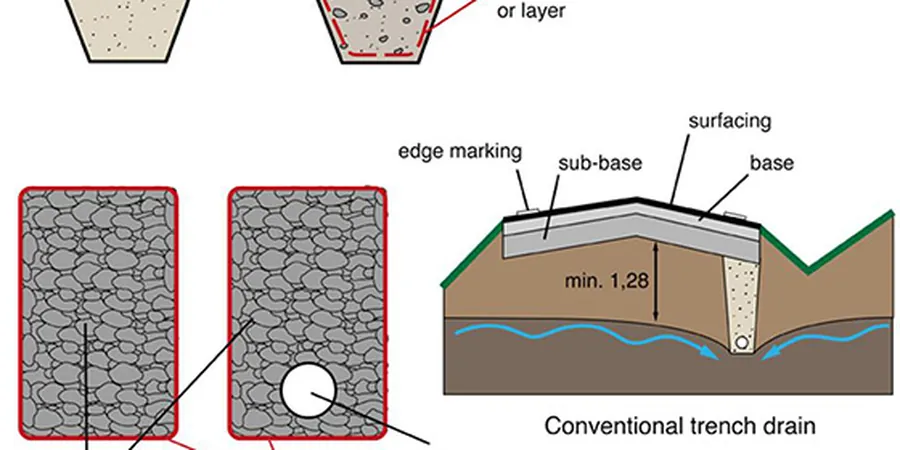
Boise's shallow water table and silty subgrades demand drainage systems designed for long-term hydraulic performance, not just peak storm events.
Process overview
- Field hydraulic conductivity testing using falling-head and constant-head methods
- Gradation analysis of drainage aggregates per ASTM C136 to ensure permeability targets
- Long-term clogging potential assessment using ASTM D5101 for geotextile compatibility
Local context
The difference between a road built on the sandy alluvium of the Boise River floodplain and one on the dense gravel terraces of the North End is night and day for drainage behavior. In the floodplain, the water table can rise to within 3 feet of the surface during spring runoff, turning a well-graded subgrade into a saturated mess that pumps under traffic. Up on the bench, the risk shifts to internal erosion of fines into the drainage aggregate, which slowly clogs the system over years. If the drainage layer isn't designed to handle both scenarios, you get pavement heave, shoulder rutting, and premature cracking. That's why we always run site-specific gradation and permeability tests before finalizing drainage specifications in Boise.
Visual overview
Reference standards
AASHTO M 288 (Geotextile specification for subsurface drainage), ASTM D4718 (Compaction control of soil-aggregate mixtures), ASTM D5101 (Geotextile clogging potential by gradient ratio), ASTM D4491 (Geotextile permittivity), ASTM C136 (Sieve analysis of fine and coarse aggregates)
Additional services
Subgrade Drainage System Design
Design of trench drains, French drains, and blanket drains including geotextile selection, gravel gradation, pipe sizing, and outlet placement. We incorporate site-specific water table data and hydraulic conductivity results to ensure long-term performance under Boise's seasonal moisture changes.
Drainage Layer Permeability Testing
Field and laboratory permeability testing on drainage aggregates and subgrade soils. We measure hydraulic conductivity under saturated conditions, evaluate clogging potential, and verify that installed materials meet design specifications per AASHTO and ASTM standards.
Typical parameters
Quick answers
What is geotechnical road drainage and why does it matter in Boise?
Geotechnical road drainage involves designing subsurface systems to intercept and remove groundwater before it reaches the pavement structure. In Boise, the shallow water table and freeze-thaw cycles make this critical — saturated subgrades lose strength, leading to rutting, cracking, and frost heave. Proper drainage extends pavement life by keeping the subgrade dry and stable.
How much does a geotechnical road drainage study cost in Boise?
A typical drainage study including field permeability tests, soil classification, and design recommendations ranges between US$820 and US$2,260 in Boise. Costs vary based on site access, number of test locations, and depth of investigation. We provide a firm quote after reviewing the project scope.
What standards do you use for drainage design in Boise?
We follow AASHTO M 288 for geotextile selection, ASTM D4718 for aggregate compaction control, and ASTM D5101 for clogging potential assessment. All drainage layer materials are tested to meet the hydraulic conductivity and filter criteria required for Boise's soil conditions.