Boise sits on the western edge of the Rocky Mountains, where Quaternary alluvial deposits from the Boise River form a deep basin of loose sands and silts. The water table here often sits less than 10 feet below ground surface. During a seismic event, these saturated granular soils can lose shear strength and behave like a liquid. That is why soil liquefaction analysis in Boise is not optional for most building projects. The 2020 IBC and ASCE 7-16 both require site-specific evaluation when peak ground acceleration exceeds 0.15g. For sites near the Boise River or its tributaries, the combination of shallow groundwater and low-density sands creates a high-risk profile. A thorough analysis helps engineers decide whether ground improvement, deep foundations, or both are needed to keep a structure safe.
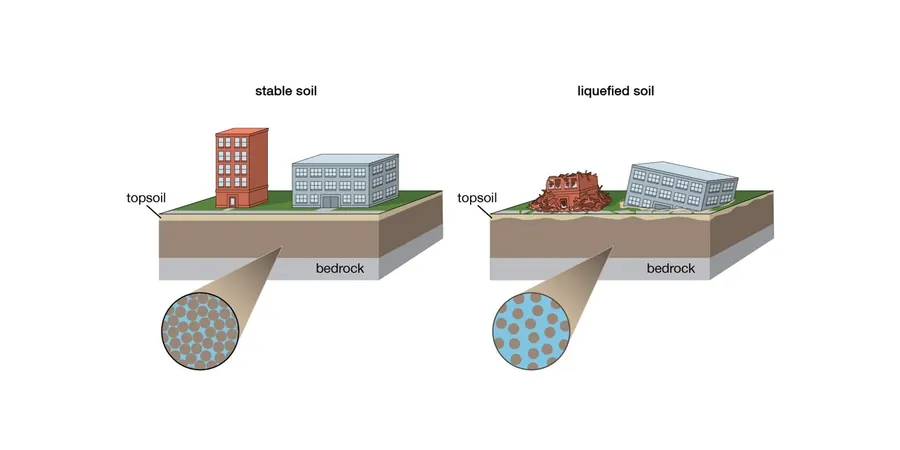
For Boise sites with shallow groundwater and loose sands, the factor of safety against liquefaction can drop below 1.0 even in a moderate earthquake.
Process overview
Local context
The Treasure Valley receives about 12 inches of precipitation per year, but irrigation and canal seepage keep the shallow aquifer recharged. That means liquefiable soils stay saturated year-round. If a magnitude 6.5 earthquake occurred on the nearby fault zone, loose sands under downtown Boise could experience excess pore pressure buildup and lateral spreading. The economic loss from building damage, broken pipelines, and tilted structures would be severe. Ignoring this risk during design is not an option. A proper soil liquefaction analysis in Boise identifies which layers will fail and at what depth. That information drives the foundation strategy and can save millions in post-event repairs.
Reference standards
ASCE 7-16 Section 11.8.3 (Site-specific ground motion), IBC 2021 Chapter 18 (Soils and foundations), Youd, T.L. & Idriss, I.M. (2001) NCEER Summary Report, ASTM D1586-18 (Standard Penetration Test), ASTM D2487-17 (Unified Soil Classification System)
Additional services
Field investigation and sampling
Boreholes drilled to 60 feet depth with SPT at 5-foot intervals. Shelby tube samples collected for lab testing. Water table measurement during drilling and after 24-hour stabilization. All work follows ASTM standards and is supervised by a licensed geotechnical engineer.
Liquefaction triggering and settlement analysis
We apply the Youd-Idriss simplified procedure to calculate factor of safety for each layer. Post-liquefaction settlement is estimated using the Tokimatsu-Seed method. Results are presented in a clear report with depth profiles, recommendations for ground improvement or deep foundations, and code compliance statements.
Typical parameters
Quick answers
How does soil liquefaction analysis differ from a standard geotechnical investigation?
A standard investigation focuses on bearing capacity and settlement under static loads. A liquefaction analysis adds specific field and lab work: SPT blow counts adjusted for fines content, cyclic triaxial testing or correlation-based triggering curves, and evaluation of post-liquefaction settlement and lateral displacement. The analysis follows the NCEER 2001 procedure and must be integrated with the buildings seismic design per ASCE 7.
What is the typical cost range for a soil liquefaction analysis in Boise?
For a standard commercial site in Boise, the cost ranges between US$2.310 and US$4.110. This includes drilling four to six borings to 50-60 feet depth, SPT testing, lab work (fines content, Atterberg limits), and a detailed report with factor of safety calculations for the design earthquake. The final price depends on site access, number of borings, and depth of investigation.
Can a soil liquefaction analysis be done on a site with existing buildings?
Yes, but the approach changes. Instead of drilling inside the building, we use cone penetration tests (CPT) from the perimeter or through existing slab penetrations. Shear-wave velocity profiling with MASW is another non-invasive option. We also review original construction documents and any previous soil reports. The goal is to characterize the liquefaction potential of the soils beneath the foundation without disrupting operations.