A common mistake we see from contractors and developers in Boise is assuming a one-size-fits-all factor of safety for their designs. The city sits on a mix of alluvial deposits from the Boise River and basalt flows from the nearby foothills, so a FS that works for a foundation in the North End may be completely inadequate for a cut slope in the Bench area. We've had clients come to us after a retaining wall failure because they used a generic FS of 1.5 without accounting for the high groundwater table typical near the river corridor. Our lab's approach starts with site-specific soil parameters — we run direct shear and triaxial tests on undisturbed samples — then we apply the correct partial factors from IBC 2021 and ASCE 7-16. For example, when evaluating a slope adjacent to a new subdivision off Bogus Basin Road, we found the in-situ cohesion was 30% lower than published regional averages, which dropped the calculated FS below 1.2. That changed the entire stabilization plan. Getting the FS right from the beginning saves costly redesigns later.
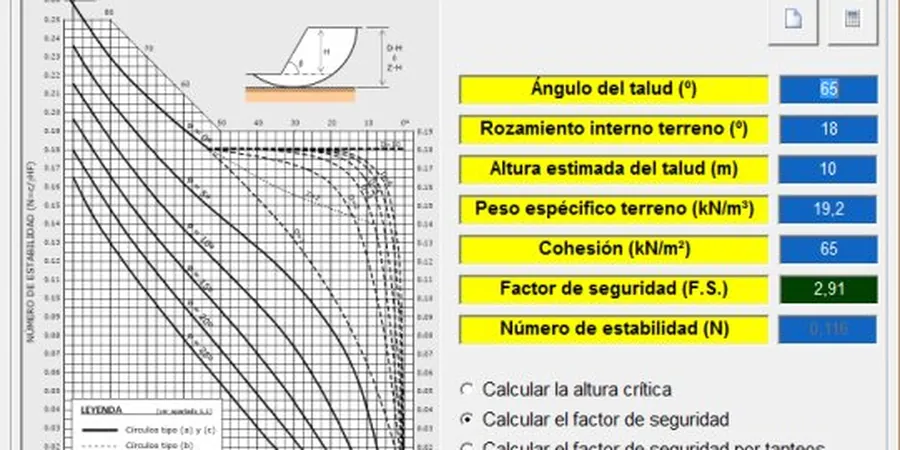
Using generic factor of safety values without site-specific parameters is the most common cause of retaining wall and slope failures in Boise.
Process overview
Local context
Boise's rapid growth since the 1990s has pushed development into areas with complex geotechnical histories. The foothills subdivisions expanded onto steep colluvial slopes, while the downtown core built over old river channels filled with loose, saturated sands. That mix of urban fill and natural slope deposits means the factor of safety for a new building pad can vary dramatically within a single block. We've analyzed sites where the calculated FS for a shallow foundation dropped from 2.0 to 1.1 just 15 meters away due to a buried paleochannel. If a designer relies on a single boring or a regional soil map, they risk underestimating the real variability. Our lab always recommends a minimum of three exploration points per site in Boise's alluvial terraces to capture that heterogeneity before assigning a final FS.
Reference standards
ASTM D3080-18 (Direct Shear Test), ASTM D7181-20 (Consolidated Drained Triaxial), IBC 2021 Section 1804.1 (Bearing Capacity and Factor of Safety), ASCE 7-16 Chapter 11 (Seismic Loads and Site Class Effects)
Additional services
Direct Shear and Triaxial Testing
We run direct shear (ASTM D3080) and triaxial compression (ASTM D2850 / D7181) on undisturbed and remolded samples to determine the cohesion and friction angle needed for FS analysis. All tests are performed in our temperature-controlled lab with daily calibration checks.
Groundwater Monitoring and Piezometer Installation
Accurate pore-pressure data is critical for FS calculation in Boise's high-water-table areas. We install standpipe piezometers and monitor levels weekly during the wet season to provide the design team with a reliable groundwater profile.
Slope Stability Modeling
Using software like Slide2 and SLOPE/W, we model the slope geometry, soil stratigraphy, and groundwater conditions to compute the factor of safety for both static and seismic scenarios. We provide contour plots and sensitivity analyses for the critical slip surface.
Seismic Site Class and Liquefaction Screening
For projects in Boise's seismic zone (Site Class C or D per IBC), we perform shear-wave velocity measurements and SPT-based liquefaction triggering analysis. The resulting site class directly affects the seismic coefficient used in pseudo-static FS calculations.
Typical parameters
Quick answers
What is the minimum factor of safety required for a retaining wall in Boise?
For a typical retaining wall in Boise, IBC 2021 requires a minimum factor of safety of 1.5 against sliding and 2.0 against overturning under static loads. For seismic conditions, the allowable FS drops to 1.1 for sliding. These values assume you have site-specific soil parameters; if you use generic values, the design engineer may increase the required FS.
How much does a factor of safety calculation cost in Boise?
For a standard residential or small commercial project, expect to pay between US$580 and US$1,630 for the full FS analysis, including soil testing, modeling, and a written report. The final cost depends on the number of borings, the complexity of the slope geometry, and whether seismic screening is required.
Why does the factor of safety vary so much across different parts of Boise?
Boise's geology includes river alluvium, basalt flows, and colluvial slope deposits, each with different strength and drainage characteristics. For example, the loose sands near the Boise River have lower friction angles and higher groundwater, producing lower FS values than the dense basalt-derived soils in the Foothills. Even within a single subdivision, buried paleochannels can cause FS to vary by 0.5 or more.
Can I use a factor of safety from a nearby project for my site?
We strongly advise against that. Boise's soil conditions are highly variable, and a FS that worked for a site 100 meters away may not apply to yours. For instance, a project on the Bench may have a stable FS of 1.8, while a site just 200 meters north on a colluvial slope might need a completely different value. Each site requires its own soil testing and analysis.